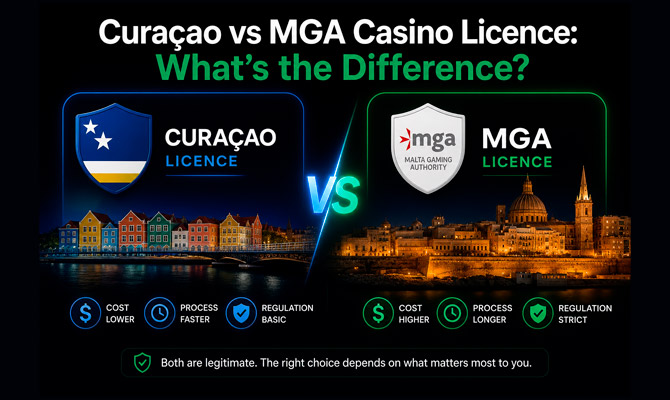

If you’ve spent any time reading casino footers, you’ve seen two licence names more than any others: MGA (Malta Gaming Authority) and Curaçao. Most players treat them as interchangeable checkmarks — “it’s licensed, so it’s fine.” They’re not interchangeable. These two frameworks differ in ways that directly affect you: what happens when a withdrawal goes wrong, whether your funds are protected if the operator goes bankrupt, and how much recourse you actually have when things don’t go your way.
This guide compares the two from the player’s perspective — not the operator’s. We’re not judging which is “better” in the abstract. We’re looking at what each licence actually guarantees (and doesn’t) when it matters.
MGA provides a mature, EU-based regulatory framework with mandatory fund segregation, a structured complaint-to-ADR path with binding conclusions, certified RNG testing, and an established enforcement track record. Curaçao under the new LOK/CGA framework has comparable player protection requirements on paper, but the enforcement track record is thin and the dispute resolution infrastructure is still maturing. Curaçao offers broader international market access (especially for crypto) and faster operator onboarding, which is why most offshore crypto casinos are licensed there — though some newer operators are migrating to even cheaper jurisdictions like Anjouan.
Side-by-Side Comparison
| Feature | MGA (Malta) | Curaçao (CGA/LOK) |
|---|---|---|
| Established | 2001 | 1996 (old system); LOK reform 2023–ongoing |
| Jurisdiction | EU member state | Caribbean (Kingdom of the Netherlands) |
| Player fund segregation | Mandatory. Operator must keep player funds in a separate, identifiable account. MGA has viewing rights. | Required under LOK, but enforcement track record is limited. The CGA framework is new — no major insolvency test cases yet. |
| Dispute resolution | Mandatory ADR (Alternative Dispute Resolution) through EU/EEA-approved entities. Structured complaint-to-ADR path with binding conclusions on the operator. Decades of institutional history. | ADR required under LOK. CADRE is the most publicly visible certified entity. System is functional but new — no long track record of resolved disputes or published statistics. |
| RNG / game fairness | Independent lab certification required (eCOGRA, iTech Labs, etc.). RTP must match advertised figures. | Required under LOK but specific testing lab requirements are less prescriptive than MGA. |
| KYC / identity verification | Mandatory before play. Strict AML framework with dedicated AML officer requirement. | Now mandatory under LOK (previously minimal). Practical implementation varies by operator. |
| Responsible gambling tools | Mandatory: deposit limits, loss limits, session time limits, reality checks. Audited by MGA. | Required under LOK. Implementation quality varies. No established audit pattern yet. |
| Self-exclusion | Operator-level only. No centralized cross-operator register (unlike UKGC’s GAMSTOP). | Operator-level. No centralized system. |
| Crypto acceptance | Handled through a cautious, policy-heavy framework. Crypto-first operators are uncommon among MGA licensees. | Explicitly permitted under standard B2C licence. Historically the dominant jurisdiction for crypto casinos — though since LOK raised costs, some newer crypto operators have migrated to cheaper alternatives like Anjouan. |
| Market access | Respected in European-facing operations. However, EU countries with their own licensing systems (Germany, Sweden, Netherlands, Spain) require separate local licences — an MGA licence alone does not grant legal access to those markets. | Primarily international/offshore. Restricted markets include at minimum the US, UK, France, Australia, Netherlands, and Curaçao itself. Does not provide legal cover in countries with their own licensing regimes. |
| Enforcement history | Established. Regular fines, licence suspensions, public registry of unauthorized domains. Thematic compliance reviews published. | Old system had minimal enforcement. New CGA framework is active but track record is short — it’s too early to assess long-term enforcement patterns. |
What Happens to Your Money
This is the most consequential difference. If the operator runs into financial trouble, what happens to the balance sitting in your account?
Under MGA: Player funds must be kept in a segregated account, separate from the operator’s working capital. The MGA has legal viewing rights over these accounts. In the event of insolvency, segregated funds are intended to be returned to players rather than absorbed into the company’s debts. This is not a 100% guarantee in every scenario — insolvency law is complex — but it’s a structural protection that meaningfully reduces your risk.
Under Curaçao: The LOK framework now requires fund segregation on paper. But the system is young, and there are no widely publicized test cases of the CGA enforcing fund protection during an operator collapse. The old sub-licence system offered essentially no meaningful fund protection. Whether the new framework delivers in a real crisis remains to be proven.
What Happens When Things Go Wrong
Your withdrawal is stuck. Support isn’t helping. Now what?
Under MGA: You go through the operator’s internal complaints process first. If that fails, you escalate to the operator’s designated ADR entity — an independent mediator approved under EU/EEA standards. The MGA’s Player Protection Directive establishes a structured complaint-to-ADR path, with ADR conclusions binding on the operator. The MGA also publishes a Player Support page where players can lodge complaints directly. This doesn’t guarantee you’ll win your dispute, but it provides a formal, institutionally backed path with decades of operational history behind it.
Under Curaçao: The LOK framework now requires operators to offer access to ADR. The most publicly visible certified entity is CADRE (Curaçao Alternative Dispute Resolution Entity), which describes itself as offering binding decisions under the LOK. Other ADR providers may also be operating under CGA certification. However, the system is new — there is no substantial public record of resolved cases, no published complaint statistics from the CGA, and no established track record comparable to Malta’s decades of ADR operation.
For a detailed walkthrough of the full escalation process (including third-party mediators like Casino Guru and AskGamblers, which work regardless of licence jurisdiction), see our what to do when a casino won’t pay guide.
Curaçao: Old System vs New System
If you encounter a Curaçao-licensed casino, it matters which Curaçao system it operates under:
Old system (pre-LOK): A handful of “master licence” holders (Antillephone N.V., Gaming Curacao, Curaçao eGaming) could issue essentially unlimited sub-licences with minimal individual oversight. The state didn’t publish complaint statistics or publicly sanction bad actors. Player protection was almost entirely dependent on the operator’s own policies. Many of the industry’s worst actors operated under this structure.
New system (LOK/CGA): Every operator needs its own licence directly from the Curaçao Gaming Authority. Applications require documentation of corporate structure, beneficial ownership, technical infrastructure, and responsible gambling procedures. KYC is now mandatory. ADR is required. The transition is ongoing — some operators are still moving from old sub-licences to new CGA licences.
The Crypto Factor
One area where Curaçao has a clear practical advantage: cryptocurrency. Curaçao explicitly permits crypto wagering under the same B2C licence that covers fiat operations. No additional crypto-specific authorization is needed — the operator just implements standard AML, wallet disclosure, and transaction monitoring controls.
The MGA has historically handled crypto through a more cautious, policy-heavy framework. Crypto-first operators are uncommon among MGA licensees. The majority of crypto casinos that players encounter — BC.Game, Stake, Roobet, Gamdom, and similar platforms — hold Curaçao licences (or are transitioning to new CGA licences under LOK).
It’s worth noting that since the LOK framework raised compliance costs, some newer and mid-tier crypto operators have migrated from Curaçao to cheaper jurisdictions like Anjouan or Tobique. The established crypto brands largely remain on Curaçao, but the landscape is shifting — a Curaçao licence is no longer the only offshore option for crypto-first operators.
For players who primarily use Bitcoin, Ethereum, or USDT, most available options will be Curaçao-licensed (or newly Anjouan-licensed). That’s not inherently dangerous, but it does mean relying on regulatory frameworks with less established player protections than MGA. See our USDT casino guide for practical considerations.
What Neither Licence Guarantees
Important to note: neither MGA nor Curaçao licensing guarantees that you’ll win disputes, that every operator will behave ethically, or that your experience will be problem-free. A licence is a regulatory framework, not an insurance policy. Specifically:
Neither guarantees a specific RTP. Both frameworks allow operators to choose from multiple RTP profiles offered by game providers. The same slot can run at 96% at one casino and 92% at another regardless of the licence. Always check the in-game paytable.
Neither prevents slow withdrawals. Processing times depend on the operator’s internal policies, payment provider relationships, and compliance procedures — not on which regulator issued the licence. Our withdrawal delays guide covers the real causes.
Neither centralizes self-exclusion. Unlike the UK’s GAMSTOP system, neither Malta nor Curaçao operates a centralized register that blocks you from all licensed operators. Self-exclusion applies only at the operator level (and its sister brands under the same company).
Looking for casinos with verified licences?
FAQ
Is an MGA licence better than Curaçao?
For player protection specifically — fund segregation, dispute resolution, and regulatory enforcement — MGA has a stronger, more established framework. Curaçao’s new LOK/CGA system has improved on the old sub-licence model significantly, but the enforcement track record is still developing. Neither is inherently safe or unsafe — the licence is one factor among many when evaluating an operator.
Why do most crypto casinos use Curaçao licences?
Curaçao explicitly permits crypto wagering under its standard B2C licence, has lower operating costs, faster approval times, and broader international market access. The MGA permits crypto but regulates it more tightly and has fewer crypto-first operators among its licensees. Curaçao became the default home for crypto-native platforms.
What’s the difference between old Curaçao sub-licences and the new CGA system?
The old system allowed master licence holders to issue sub-licences with minimal individual oversight. The new LOK framework requires each operator to apply directly to the Curaçao Gaming Authority, with documented compliance, KYC requirements, and mandatory ADR. The transition is ongoing — check the operator’s licence seal to determine which framework they operate under.
Can I file a complaint against a Curaçao-licensed casino?
Under the new LOK framework, yes — through the operator’s ADR entity (CADRE or ADRC). You can also file with third-party mediation services like Casino Guru and AskGamblers, which operate independently of the licence jurisdiction. For detailed steps, see our dispute resolution guide.
Does the licence affect what games are available?
Indirectly, yes. MGA-licensed operators tend to carry games from providers that are also MGA-certified (Pragmatic Play, Evolution, NetEnt, etc.). Curaçao-licensed operators often have access to the same major providers plus smaller studios and provably fair originals. Bonus buy features are available under both jurisdictions (unlike the UK where they’re banned). The game library depends more on the operator’s agreements with providers than on the licence itself.
Related
- How to check if a casino is legit — 7-point verification checklist
- Casino operator groups explained — why your 5 casinos might be 1 company
- Casino not paying — step-by-step escalation guide
- KYC guide — what you need to submit and how to pass faster