
Before you deposit money at any online casino, you should verify that it’s legitimate. This isn’t about reading one review and trusting it — it’s about running your own checks using publicly available data.
This article gives you a 7-point checklist you can apply to any casino, anywhere. It’s a user-facing version of the same verification workflow we use for our Trust Floor process, simplified for individual players.
1. Correct domain? — Verify you’re on the real site, not a clone (check URL spelling carefully)
2. Safety Index above 7.0? — Search the casino on Casino Guru
3. License in footer? — Click the license seal — if it’s a static image with no link, be suspicious
4. No “no reaction” complaints? — Search “[casino name] complaint” on Casino Guru
If all four pass, the casino clears the basic safety threshold. Keep reading for the deep-dive on T&C, payments, and operator groups.
• No verifiable operator name anywhere on the site
• No working license lookup (dead link, static image, or expired certificate)
• Repeated unresolved withdrawal complaints on Casino Guru or AskGamblers
• T&C with vague “right to void winnings at management’s discretion”
• Payment methods shown for deposit but missing from the withdrawal page
• URL doesn’t match the known casino domain (phishing clone)
This guide is about verifying casinos yourself. If you’d rather skip the research, our quiz only recommends casinos that have already passed this verification.
0 Verify You’re on the Real Site
Before any other check: make sure you’re on the correct domain. Casino phishing is a real and growing problem in crypto gambling. Scammers clone entire casino websites with near-identical designs and register domains like staке.com (Cyrillic “а”), bitstarz.io (wrong TLD), or riobet-casino.com (added suffix).
How to verify:
- Check the URL letter by letter. Homoglyph attacks use similar-looking characters from different alphabets.
- Use Casino Guru or AskGamblers as a reference. Search the casino there first, then click through to the official site from their review page — they verify domains.
- Bookmark the correct domain after your first verified visit. Don’t rely on Google ads or search results for subsequent visits — ads can be hijacked.
If you’re on the wrong site, every other check on this page is meaningless. Start here.
1 Check the Safety Index
Casino Guru maintains a Safety Index for over 7,000 online casinos, rated on a scale from 0 to 10. The index evaluates T&C fairness, complaint resolution history, estimated revenue, licensing, and blacklist status.
How to use it:
- Go to casino.guru/online-casinos
- Search for the casino by name
- Look at the Safety Index score in the review header
What the scores mean:
- 9.0–10.0 (Very High): Excellent track record. Low complaint volume relative to size. Clean T&C.
- 7.0–8.9 (High): Solid. Some complaints may exist but resolution rate is acceptable.
- 5.0–6.9 (Medium): Proceed with caution. May have unresolved complaints or questionable clauses.
- Below 5.0 (Low / Very Low): Significant red flags. Consider avoiding.
Casino Guru’s Safety Index is one of the most useful public screening tools for online casinos. It’s a strong starting point — but not the final word. Use it alongside the other checks on this page, not as a substitute for them.
2 Verify the License
A gambling license means a regulatory body has granted the casino permission to operate. Not all licenses provide the same level of player protection. The table below is our simplified editorial model — regulatory nuances exist within each tier.
| Tier | Jurisdictions | Player Protection |
|---|---|---|
| Tier 1 | UKGC (UK), MGA (Malta), Ontario (AGCO + iGaming Ontario) | Highest. Strict enforcement, mandatory complaint handling, player fund segregation. |
| Tier 1.5 | Gibraltar, Isle of Man | Strong historically. Close to Tier 1 in practice, especially for EU/UK markets. |
| Tier 2 | Curaçao Gaming Authority (CGA, 2024+) | Moderate. New CGA framework is significantly stricter than old Curaçao. Verify against current official registry. |
| Tier 3 | Anjouan (Comoros), Kahnawake, Panama, legacy Curaçao sublicenses | Lower. Limited player recourse. Licensing serves as legal formality. |
| No license | — | None. No regulatory oversight. Avoid. |
How to verify:
- Scroll to the casino footer — the license number and jurisdiction should be displayed
- Click the license seal. A legitimate license seal is a dynamic link to the regulator’s validation page (e.g., on the regulator’s own domain). If the seal is a static image with no link, that’s a warning sign.
- Cross-check with the regulator’s public registry (e.g., MGA’s license holder list)
- For Curaçao, verify the operator against the current official licensing framework. Vague references to legacy master licenses without specific CGA registration are a caution sign.
Most crypto casinos in our pool hold Curaçao or Anjouan licenses (Tier 2 to Tier 3). This is standard for the crypto gambling market. A Curaçao license alone doesn’t make a casino safe, but no license at all is a definitive red flag.
3 Read the Complaint History
Complaints reveal patterns that marketing pages won’t show you. Two platforms provide structured complaint data:
- Casino Guru Complaint Resolution Center — structured cases with casino responses, player rebuttals, and mediator verdicts
- AskGamblers AGCCS — similar complaint tracking with casino response timelines
What to look for:
- Complaint volume relative to casino size. A large casino with 50 complaints over 5 years is different from a small casino with 50 complaints in 6 months.
- Resolution rate. What percentage of complaints were resolved in the player’s favour?
- Withdrawal delay patterns. Multiple complaints about payouts stuck in “processing” for weeks suggest systematic stalling.
- KYC weaponization. If you see a pattern of “verification delayed for weeks/months” — requests for notarized documents, selfies with passport next to support chat screenshots, repeated escalations with no resolution — this is a deliberate strategy to make players give up on their withdrawals. Treat it as seriously as having no license.
- “No reaction” cases. If the casino doesn’t respond to mediator inquiries, that’s one of the most serious red flags.
You can also search directly: try “[casino name] withdrawal delay”, “[casino name] KYC problem”, or “[casino name] confiscated winnings” in Google to find player reports outside of formal complaint platforms.
4 Scan the T&C for Red Flags
Terms and Conditions are legally binding. Casinos can — and do — use T&C clauses to deny withdrawals. Before depositing, scan for these specific red flags:
- Dormant balance confiscation. Some casinos take your remaining balance after 30–90 days of inactivity. This should be prominently disclosed, not buried in clause 47.
- Unreasonable max cashout from winnings. A clause like “maximum withdrawal from bonus winnings is $100” makes large wins meaningless. See our bonus math breakdown for how this affects real value.
- Extended withdrawal “review periods.” Some operators reserve the right to review any withdrawal for up to 30 days. This effectively means your money is frozen for a month while the casino decides whether to pay you.
- “Right to void” at sole discretion. Casinos that reserve the right to void any bet or win “at management’s sole discretion” without specifying criteria are giving themselves an escape hatch for any dispute.
- Undefined max bet penalties. If the T&C doesn’t define a clear max bet amount during bonus play but punishes “irregular play” or “excessive betting,” you can lose your bonus without knowing you violated a rule.
- KYC triggered only at withdrawal. If the casino never asks for verification during deposits but demands extensive documentation when you try to withdraw, the asymmetry is intentional.
- Source-of-funds escalation. Some casinos require bank statements, payslips, or proof of income for withdrawals above a certain threshold — sometimes as low as $500. Check whether the T&C mentions “source of funds” or “source of wealth” requirements.
- Withdrawal reversal windows. Some casinos give you a “pending period” (24–72 hours) during which you can cancel your withdrawal and return the money to your casino balance. This is designed to encourage continued play. Not illegal, but predatory.
Casino Guru’s review for each casino includes a T&C evaluation. If their review notes “unfair” or “predatory” clauses, take that seriously — their team reads these documents professionally.
5 Identify the Operator Group
Many casinos that look independent are actually run by the same company. Knowing the operator group tells you two things: the shared infrastructure (and its reliability), and whether complaints at one brand might indicate risk at others.
Common operator groups in the crypto casino space:
- Galaktika N.V. — Jet, Fresh, Sol, Drip, Legzo, Rox, Monro (7 brands)
- Globonet B.V. — Play Fortuna, Booi, Jozz (3 brands)
- Pomadorro — Joycasino, Casino-X (2 brands)
- Independent — Bitstarz, Stake, Gamdom, BC Game, Roobet, Fairspin, Winz, Vavada, Vodka, Shuffle, Ramenbet
How to find the operator: scroll to the casino footer or check the “About” and “Terms” pages. The operating company name (e.g., “Operated by Galaktika N.V.”) is usually listed near the license information.
An operator group isn’t inherently bad. But if one brand in the group has systemic complaints, check whether the same issues appear across siblings. Shared infrastructure means shared policies — both the good and the problematic ones.
6 Check Payment Methods & Withdrawal Limits
Before depositing, verify:
- Which methods are available for withdrawal — not just deposit. Some casinos accept credit card deposits but only allow crypto withdrawals. Others accept crypto deposits but process payouts exclusively in fiat. The asymmetry is intentional.
- Minimum withdrawal amount. If it’s $50 or higher, small-budget players may struggle to ever cash out.
- Daily and monthly withdrawal limits. Caps like “$1,000/day and $7,500/month” mean a $10,000 win takes weeks to withdraw. Higher VIP tiers typically raise these limits.
- Processing times. “Instant” for crypto may genuinely mean minutes. “Instant” for fiat usually means 1–3 business days. Check whether the T&C includes a “review period” clause that adds delays beyond the stated timeframe.
7 Look for Community Reputation
After checking the institutional sources (Casino Guru, AskGamblers, license registries), look at what actual players say in less curated spaces:
- Reddit — subreddits like r/gambling, r/onlinegambling, and r/bitcoin often have first-hand player reports
- Bitcointalk — the gambling section has discussion threads for many crypto casinos going back years
- Trustpilot — casinos can solicit positive reviews and respond strategically to negative ones. Patterns of similar negative feedback are meaningful; individual 5-star reviews with generic text are often astroturfed.
- Casino-specific Telegram groups — some casinos run official groups where you can observe player interactions with support in real time
Community sources are noisy in both directions. Negative posts can come from frustrated players who didn’t read the T&C. Positive posts can come from affiliates, paid reviewers, or casino staff posing as players. Look for patterns from unrelated accounts reporting the same issue over months. A single post — positive or negative — is not a signal.
Putting It All Together
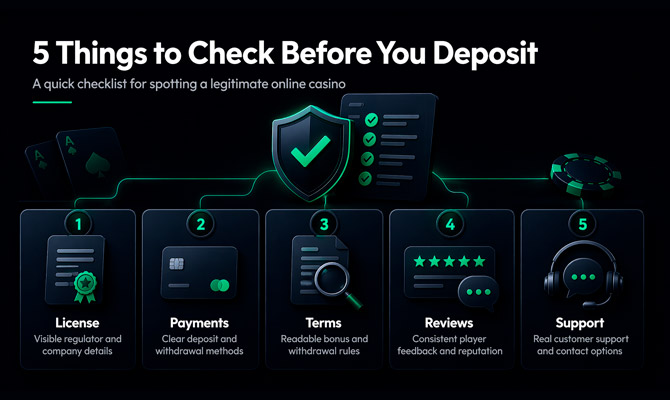
| Check | What It Catches | Time |
|---|---|---|
| Domain verification | Phishing clones | 30 seconds |
| Safety Index | Overall risk level | 1 minute |
| License verification | No license / fake license | 2–3 minutes |
| Complaint history | Payment patterns, KYC abuse | 5–10 minutes |
| T&C red flags | Predatory clauses, hidden restrictions | 10–15 minutes |
| Operator group | Cross-brand risk | 2 minutes |
| Payment methods | Withdrawal restrictions, limits | 3–5 minutes |
| Community reputation | Real experiences, astroturfing | 5–10 minutes |
Total time: 30–45 minutes for a thorough check. The express version (domain + Safety Index + license + complaints) takes 3 minutes and catches the majority of clear scams.
We run this verification for every casino before it enters our quiz pool.
Take the 60-second quiz — all 25 casinos are pre-verified →
See our Trust Floor methodology for the full verification framework.
What These Checks Won’t Tell You
- RTP configurations. Some games display the active RTP in their rules/paytable menu — open the game and check the ℹ️ icon before spinning. But many offshore operators don’t surface this data, making full verification from the outside difficult without creating an account and inspecting each title individually.
- Future behaviour. A clean track record today doesn’t guarantee tomorrow. Casinos can change ownership, management, or policies. Monitoring matters — our pool is re-verified quarterly.
- Individual outcome. Even the safest casino operates with a house edge. Passing all seven checks doesn’t mean you’ll win — it means the platform is less likely to create problems when you try to withdraw what you’ve won.
Frequently Asked Questions
How can I tell if an online casino is a scam?
The strongest signals are: no verifiable operator name, no working license link (static badge = fake), Casino Guru Safety Index below 5.0, multiple unresolved complaints about withheld withdrawals, and T&C clauses allowing discretionary voiding of winnings. Two or more red flags together is a strong warning. Also verify you’re on the correct domain — phishing clones are a growing problem in crypto gambling.
Is a Curaçao license enough to trust a casino?
A Curaçao license provides basic legal standing but less player protection than Tier 1 regulators (UKGC, MGA). The new CGA framework (2024+) is stricter than old Curaçao, but enforcement still lags behind MGA. Most crypto casinos operate under Curaçao or similar offshore licenses. The license alone is not enough — check complaint history, T&C fairness, and operational track record alongside it.
What is the Casino Guru Safety Index?
It’s a 0–10 score assigned by Casino Guru based on T&C evaluation, complaint resolution history, estimated revenue, licensing, and blacklist status. It’s one of the most useful public screening tools for evaluating casino safety. Our Trust Floor uses it as the primary external signal with a minimum threshold of 7.0/10.
How do I know if a casino is using a fake license?
Click the license seal in the casino’s footer. A legitimate seal is a dynamic link that opens a validation page on the regulator’s own domain (e.g., mga.org.mt, or the CGA validator). If the seal is a static image with no link, or the link points to a different domain, the license is almost certainly fake. Always cross-check the operator name against the regulator’s public registry.
Are casino reviews on affiliate sites reliable?
It varies widely. Many affiliate reviews are structured to promote casinos that pay the highest commissions. Look for reviews that disclose methodology, show specific data (safety scores, complaint counts, T&C analysis), and are willing to criticise casinos they link to. If every casino on a site gets 4+ stars and no review mentions a single downside, the reviews are probably not independent.
What should I do if a casino won’t pay my withdrawal?
First, check whether any bonus wagering requirements are still active — unfinished wagering is the most common reason for blocked withdrawals. If wagering is complete: contact support and document the conversation (screenshots). If unresolved after 48 hours: file a complaint with Casino Guru or AskGamblers. Both platforms mediate disputes, and casinos often respond faster to third-party complaints than to direct support tickets.
Should I avoid all casinos with a Tier 3 license?
Not necessarily. Some reputable crypto casinos operate under Anjouan or similar Tier 3 licenses because their target market doesn’t require Tier 1 compliance. The license tier indicates the level of regulatory recourse available to you — not whether the casino itself is trustworthy. Use the full checklist on this page rather than filtering by license tier alone.
Further Reading
- Our scoring methodology — how we apply these checks at scale across 25 casinos
- How we test and verify casinos — our internal verification workflow
- Casino bonus math — understand wagering requirements before opting into any offer
- Casino Guru database — search for any casino’s Safety Index
- BeGambleAware — support and resources for responsible gambling