
USDT (Tether) is the most popular stablecoin at online casinos — and for good reason. Pegged 1:1 to the US dollar, it gives you the speed and privacy of crypto without the price volatility of Bitcoin or Ethereum. A $500 deposit stays worth $500 while you play, and a $500 withdrawal arrives as $500.
But USDT exists on multiple blockchains simultaneously, and choosing the wrong one can cost you money — or lose your funds permanently. This guide covers the three networks you’ll see in casino cashiers, what each one costs, and the mistakes that catch first-time crypto depositors.
TRC-20 (Tron) is the most commonly supported network at crypto casinos — fast, cheap, and near-universally available. But the cheapest practical route depends on what the casino supports and what your exchange charges. BEP-20 and Polygon can be even cheaper when available. ERC-20 (Ethereum) works but costs more and confirms slower. The one non-negotiable rule: never mix networks. Sending USDT through a network the casino doesn’t support can result in lost funds.
Why USDT Instead of Bitcoin or Ethereum?
Three practical advantages make USDT the default stablecoin for casino players:
No price volatility. Bitcoin can move 5–10% while you’re playing a session. That means your $500 deposit might be worth $450 or $550 by the time you withdraw — regardless of whether you won or lost at the tables. USDT stays at $1. Your bankroll is denominated in stable dollars from deposit to withdrawal.
Lower and more predictable fees. Bitcoin transaction fees can spike from $2 to $50 depending on network congestion. Ethereum gas fees are similarly unpredictable. USDT on TRC-20 stays consistently cheap — typically $1–4, and often near-zero for users with staked TRX resources.
Cleaner bankroll tracking. When your deposit and withdrawal are both denominated in a dollar-pegged currency, you know exactly how much you won or lost. No need to calculate exchange rate movements on top of your gambling P&L. For a broader comparison of crypto and traditional payment methods, see our Crypto vs Traditional Casino guide.
The Three Networks: TRC-20 vs ERC-20 vs BEP-20
This is the part most players get wrong on their first deposit. USDT is not a single coin on a single blockchain. Tether Ltd. issues the token on multiple networks — Ethereum, Tron, BNB Chain, Solana, and others. Each version is worth $1, but the transfer speed, cost, and wallet compatibility differ by network.
Three networks dominate casino cashiers:
| Network | Blockchain | Typical Fee | Confirmation Time | Casino Support |
|---|---|---|---|---|
| TRC-20 | Tron | Varies: near-zero (staked TRX) to $1–4 | Under 2 minutes | Near-universal |
| ERC-20 | Ethereum | $2–15+ (varies with gas) | 5–15 minutes | Widely supported |
| BEP-20 | BNB Chain | $0.01–$0.50 | Under 2 minutes | Growing, not universal |
| Polygon | Polygon PoS | $0.01–$0.05 | Under 2 minutes | Growing — check cashier |
TRC-20 (Tron) — the common default
Tron carries a large share of circulating USDT, which is why most crypto casinos support TRC-20. Transfers typically confirm quickly — under two minutes in normal conditions. Fees depend on whether your wallet has staked TRX for energy and bandwidth resources: if it has, transfers can cost near-zero; if not (and most casual users don’t bother), expect roughly $1–4, though this varies by wallet implementation and exchange withdrawal policies. Still consistently cheaper than Ethereum.
ERC-20 (Ethereum) — works, but costs more
ERC-20 is the original USDT standard and remains widely supported. The downside is Ethereum gas fees, which fluctuate based on network demand. During quiet periods, a transfer might cost $2–5. During congestion spikes, the same transfer can cost $15 or more. Credit time depends on the receiving platform’s confirmation policy — typically 5–15 minutes, but not guaranteed by the protocol itself. ERC-20 makes sense if you’re moving large amounts (where the fee is negligible relative to the transfer size) or if your wallet or exchange only supports Ethereum-based USDT.
BEP-20 and Polygon — the cheaper alternatives
BNB Chain (BEP-20) and Polygon both offer fees significantly lower than TRC-20 — often under $0.05 — with comparable speed. The limitation is adoption: not every casino lists these networks in its cashier. If the operator supports them, they’re excellent choices, especially for frequent small deposits. Polygon in particular has gained traction at major crypto platforms like Stake and BC.Game. Always verify network support in the cashier before sending.
How to Deposit USDT at a Casino (Step by Step)
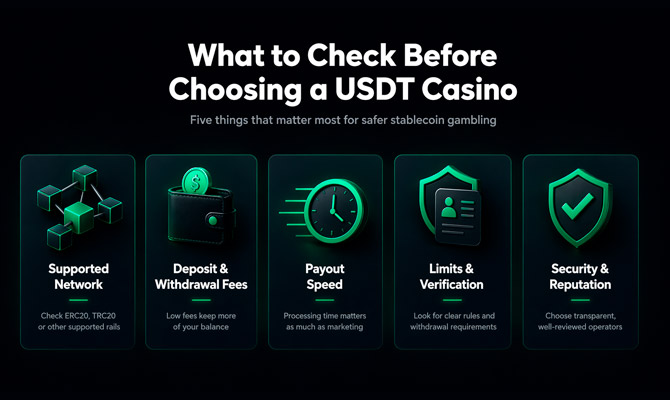
Step 1: Buy USDT on an exchange (Binance, Kraken, Coinbase, or similar) using a bank transfer, card, or other crypto. If you already hold USDT in a personal wallet, skip this step.
Step 2: Go to the casino’s cashier section. Select USDT as the deposit method. The cashier will display a dropdown for network selection — choose TRC-20 (or your preferred network).
Step 3: The casino generates a unique deposit address (a long string of characters) and usually a QR code. Copy this address exactly — character by character.
Step 4: In your exchange or wallet, initiate a withdrawal to the copied address. Verify the network matches. If the casino address is TRC-20, your sending network must also be TRC-20. Enter the amount and confirm.
Step 5: Wait for blockchain confirmations. TRC-20 deposits typically credit within 1–3 minutes. ERC-20 may take 5–15 minutes. Once confirmed, the USDT appears in your casino balance.
The Three Mistakes That Lose Your Money
Mistake 1: Sending to the wrong network
Mistake 2: Copying the wrong address
Casino deposit addresses are long strings of characters. One wrong digit means the funds go to a non-existent address or — worse — someone else’s wallet. Always copy-paste (never type manually) and verify at least the first and last 4–6 characters match. Some malware is designed to swap clipboard addresses, so verify the pasted address against the original before confirming.
Mistake 3: Ignoring the casino’s minimum deposit
Most operators set a minimum USDT deposit (commonly $10–$20). Sending less than the minimum means the transaction processes on-chain but the casino doesn’t credit your balance. Recovering these micro-deposits from support is possible but time-consuming. Check the minimum before sending.
Withdrawing USDT: What to Expect
The withdrawal process mirrors the deposit in reverse: go to the cashier, select USDT, choose your network (match the one your receiving wallet supports), paste your personal wallet address, and confirm.
Two variables determine how fast your USDT withdrawal arrives:
Casino processing time — the operator’s internal review before releasing the payment. At well-run crypto casinos, this is automated and takes minutes. At others, it involves manual compliance review that can take hours or days. See our Instant Withdrawal guide for the full breakdown.
Blockchain settlement time — once the casino sends the transaction, TRC-20 confirms in under 2 minutes and ERC-20 in 5–15 minutes. This part is outside the operator’s control.
USDT vs Bitcoin vs Ethereum for Casino Use
| Factor | USDT (TRC-20) | Bitcoin | Ethereum |
|---|---|---|---|
| Price stability | Pegged to $1 — no volatility | High volatility (±5–10% daily) | High volatility |
| Transfer fee | $1–4 | $2–50 (variable) | $2–15+ (gas) |
| Confirmation time | Under 2 min | 10–60 min | 5–15 min |
| Bankroll tracking | Clean (dollar-denominated) | Complex (BTC price changes) | Complex (ETH price changes) |
| Upside potential | None (that’s the point) | Yes (if price rises) | Yes (if price rises) |
| Casino support | Near-universal for crypto sites | Near-universal | Very common |
USDT wins on stability, fees, and simplicity. Bitcoin wins if you want exposure to price appreciation (a gamble on top of your gamble). For most players whose primary goal is playing casino games — not speculating on crypto markets — USDT is the more practical choice.
The Risks of Using USDT (Honest Assessment)
USDT is not risk-free. Two systemic risks are worth understanding:
Issuer and reserve risk. Tether Ltd. states that USDT is pegged 1:1 to the US dollar and 100% backed by reserves. This claim has been subject to years of industry scrutiny and regulatory attention but has not resulted in a de-peg event. However, issuer risk, reserve composition risk, and potential regulatory action remain non-zero factors — especially for players holding large USDT balances between sessions rather than depositing and withdrawing within a single session.
Regulatory uncertainty. Different jurisdictions treat stablecoins differently. In some regions, using USDT at offshore casinos may create tax or legal complications that using fiat does not. This article is not tax advice — consult a professional if your jurisdiction has specific rules around cryptocurrency gambling.
Our quiz matches you with operators that support USDT deposits — and factors in withdrawal speed and bonus terms.
FAQ
Which USDT network should I use for casino deposits?
TRC-20 (Tron) is the most commonly supported option — fast and cheap at most casinos. BEP-20 and Polygon can be even cheaper when available. The best choice depends on what the casino supports and what your exchange charges for that network’s withdrawal. Use ERC-20 only as a last resort or for large transfers where the fee is negligible.
What happens if I send USDT on the wrong network?
In most cases, the funds are unrecoverable. The biggest danger is between EVM-compatible networks (ERC-20, BEP-20, Polygon, Arbitrum) — they all use the same “0x…” address format, so your wallet won’t flag the mismatch. Recovery is sometimes possible if the casino holds the private key for that address and is willing to help, but most operators explicitly state they don’t perform cross-chain recovery. Always verify the network name — not just the address format — before confirming.
Do casinos charge fees for USDT deposits?
Most crypto casinos don’t charge a deposit fee on their end. You pay only the blockchain network fee — typically $1–4 on TRC-20, higher on ERC-20 depending on gas prices. Some operators absorb the network fee for deposits above a certain threshold.
Can I deposit USDT and withdraw in Bitcoin?
It depends on the operator. Some casinos allow cross-currency withdrawals; others require you to withdraw in the same coin and network you deposited with. Check the cashier terms or ask support before depositing if this matters to you.
Is USDT safer than Bitcoin for casino use?
Safer in terms of price stability — your balance won’t drop 10% overnight. But USDT carries its own risks: the stablecoin peg depends on Tether Ltd.’s reserves, and regulatory changes could affect availability. Neither is universally “safer”; they manage different kinds of risk.
Where can I buy USDT?
Any major cryptocurrency exchange — Binance, Kraken, Coinbase, Bybit, OKX. You can purchase with a bank transfer, debit card, or by swapping other crypto. Some casinos also offer in-cashier card-to-crypto purchases through third-party processors like MoonPay, though fees for this service are typically higher than buying on an exchange directly.
Related
- Crypto Casino vs Traditional Casino — speed, limits, and privacy compared
- Instant Withdrawal Casinos — what “instant” really means for crypto payouts
- Why Withdrawals Get Delayed — the 6 causes and how to fix them
- USDTBookmakers — our dedicated USDT sportsbook and casino resource