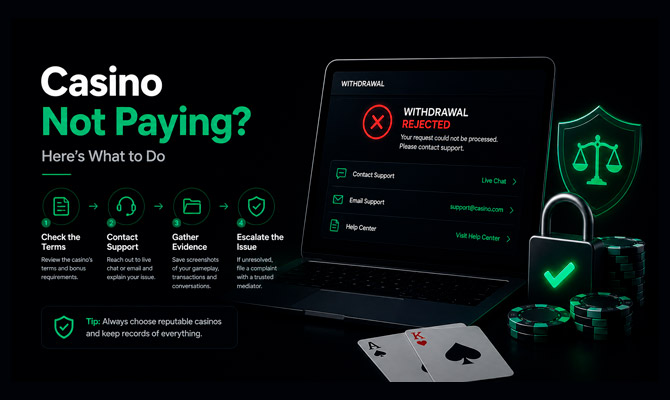

Your withdrawal is stuck. Customer support isn’t helping. You’re not sure if you did something wrong or if the operator is stalling. This guide walks you through the escalation path — from self-diagnosis to third-party mediation to regulator complaints — so you know exactly what to do at each stage and what to realistically expect.
Step 0: Rule Yourself Out First
Before contacting anyone, verify that the delay isn’t caused by something on your end. These are the most common reasons a legitimate operator will hold your withdrawal:
| Reason | What to check | How to fix |
|---|---|---|
| KYC not complete | Check your account verification status. Most platforms require identity documents before processing any payout. | Submit ID, proof of address, and payment method proof. See our KYC guide for what’s needed. |
| Wagering not met | Check your bonus status. If you accepted a deposit bonus, you may need to wager 30×–50× the bonus amount before withdrawing. | Complete the wagering or forfeit the bonus. See our wagering math guide. |
| Withdrawal below minimum | Check the minimum withdrawal amount for your chosen payment method. It can range from $10 to $100. | Adjust the withdrawal amount or switch payment methods. |
| Withdrawal above daily/weekly limit | Check the operator’s T&C for daily, weekly, or monthly caps. Some platforms limit payouts to $5,000–$10,000/week. | Your withdrawal may be split across multiple payouts. See our withdrawal limits guide. |
| Pending review period | Many operators have a 24–72 hour “pending” window before processing begins. | Wait for the stated processing time to pass before escalating. |
| Payment method mismatch | Some operators require you to withdraw via the same method you deposited with. | Check deposit history and request withdrawal to the matching method. |
If none of these apply and your withdrawal has been stuck beyond the operator’s stated processing time — now it’s time to escalate.
The Escalation Path
1
Contact Customer Support (and document everything)
Use live chat first — it’s faster than email and creates a written record. Ask specifically: “What is the reason my withdrawal request #[number] has not been processed?” Get a clear answer in writing.
What to document: Screenshot every chat session. Save all emails. Note the date, time, agent name (if provided), and the exact reason given. If they say “under review” or “pending verification,” ask for a specific timeline. If they can’t give one, ask for a case/ticket number and a manager escalation.
Timeline: Give them the processing time stated in their T&C (usually 3–5 business days) plus a reasonable buffer. If nothing happens after 7–10 days with no clear explanation, move to Step 2.
2
Send a Formal Written Complaint
Email the operator’s complaints department (usually listed in the T&C or footer). This is not the same as live chat. Most licensed operators are required to have a formal complaints process with stated response timeframes — these vary by operator and licensing jurisdiction, but the key point is that a formal complaint triggers a documented obligation that live chat does not.
Your email should include: your account username, the withdrawal request ID, the date the request was made, the amount, the payment method, a summary of what support told you, and your expectation (e.g., “process within 5 business days or provide a written explanation”).
Why this matters: A formal complaint creates a paper trail that regulators and mediation services will require before they intervene. Without it, most third parties will send you back to this step.
3
File with a Third-Party Mediation Service
If the operator’s internal process doesn’t resolve the issue (or they don’t respond at all), third-party mediators are the next step. The two main options:
Casino Guru Complaint Resolution Center — the largest service in this space, with over 60,000 complaints published and more than $60 million returned to players since launch. In Q1 2026, their team resolved over 1,300 cases and returned roughly $5.3 million. The service is free for players. Each case gets a dedicated mediator who communicates with both you and the operator. Resolution times vary widely depending on operator responsiveness — some cases close in days, others take months. You can submit a complaint on their site.
AskGamblers Casino Complaint Service (AGCCS) — operating since 2009, with over 36,000 complaints processed and more than $82 million returned to players according to their published data. Also free for players. The submission process and mediation model are similar to Casino Guru’s — you provide evidence, they contact the operator, and they work toward a resolution.
What to expect: These services are mediators, not authorities. They can pressure the operator through public visibility (unresolved complaints affect the operator’s rating and listing status), but they cannot force payment. Resolution depends on the platform’s willingness to cooperate. Licensed operators are far more likely to respond than unlicensed ones.
4
Complain to the Licensing Authority
If mediation fails or the operator is completely unresponsive, file a complaint with the regulatory body that issued the operator’s licence. This information is usually displayed in the casino’s footer.
Common regulators:
MGA (Malta Gaming Authority) — requires operators to respond to player complaints. You can file through their online complaint form. They require proof that you’ve already gone through the operator’s internal process.
Curaçao — Curaçao now has a formal CGA/LOK regulatory structure, but player-facing dispute outcomes remain less predictable than under MGA or UKGC frameworks. Many operators still hold sub-licences under older master licence holders (such as Antillephone N.V. or Gaming Curacao). To identify the right contact: click the licence validator seal (usually a coat of arms) in the casino’s footer — it will show the specific licence holder and their complaint portal. File there first, then with the CGA if needed.
UKGC (UK Gambling Commission) — UK operators must have a formal complaints procedure and offer access to an approved ADR (Alternative Dispute Resolution) provider. The Commission itself does not mediate individual disputes directly. Typically, if your complaint remains unresolved after 8 weeks through the operator’s internal process, you can escalate to the operator’s designated ADR service.
Important: If the operator has no visible licence or uses a licence from a jurisdiction you can’t identify, your options become very limited. This is why verifying licences before depositing matters — see our legitimacy checklist.
5
Public Pressure and Community Forums
Posting a detailed, factual, evidence-backed account of your experience on public forums can sometimes accelerate resolution — especially with operators who monitor their reputation closely. Useful platforms include the Casino Guru forum, AskGamblers community section, and relevant Reddit communities (r/onlinegambling, r/gambling).
Rules: Stay factual. Include dates, amounts, and what happened at each step. Avoid emotional language or threats. A well-documented post with evidence is far more effective than an angry rant. Some operators have community managers who respond to public complaints faster than internal support handles private ones.
6
Legal Action (Last Resort)
For significant amounts, consulting a lawyer who specialises in gambling law may be worthwhile. Some firms operate on a no-win-no-fee basis for gambling disputes.
On chargebacks — proceed with extreme caution. Filing a chargeback on a gambling deposit because the operator delayed your withdrawal is classified by payment networks as “friendly fraud.” The operator will provide the card network with session logs proving you deposited voluntarily and played. In the vast majority of cases, the chargeback will be denied — and you risk being flagged in anti-fraud databases (Iovation, SEON, etc.), which can block you from depositing at any licensed platform in the future. Chargebacks are designed for unauthorised transactions (stolen cards, unknown charges), not for dispute resolution with a gambling operator. Card dispute recoverability depends on your issuer, the payment network’s scheme rules, merchant coding, and your jurisdiction.
Reality check: Legal action is expensive and slow. For disputes under a few thousand dollars, the cost of pursuing legal remedies often exceeds the disputed amount. It’s almost always more effective to resolve through mediation (Step 3) or regulatory complaint (Step 4) first.
When the Operator Is Actually Right
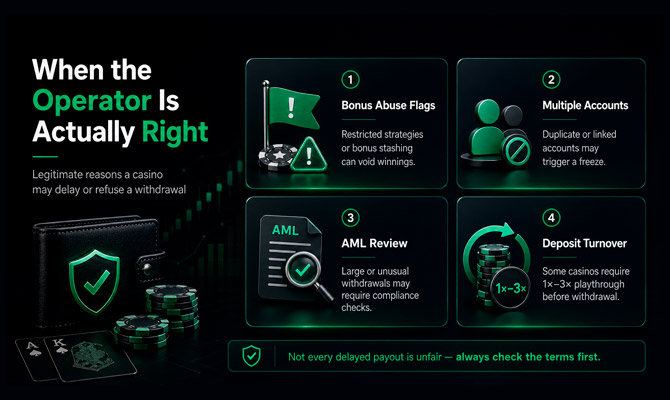
Not every withheld withdrawal is unfair. Operators have legitimate reasons to delay or refuse payment — and understanding them helps you avoid the situation in the first place:
Bonus abuse flags. Operators monitor for patterns they classify as abuse. Classic examples include betting on opposing outcomes to guarantee wagering progress with minimal risk. A more common trigger in 2026 is bonus stashing (also called “feature parking”): a player triggers a bonus round (free spins) while playing on bonus funds, closes the game before the feature plays out, cancels or lets the bonus expire, then reopens the game to play the stored feature on real money — bypassing wagering requirements entirely. Operators treat this as a terms violation and will void associated winnings. Read the restricted strategies section of any bonus T&C before accepting.
Multiple account detection. If the operator believes you’ve created more than one account (which violates terms at virtually every platform), they can freeze all accounts and confiscate balances. This applies even if the second account was accidental or created by a family member on the same network.
AML (anti-money laundering) review. Large or unusual withdrawal patterns can trigger compliance reviews that take days or weeks. The operator may not be able to explain the exact reason during this process due to “tipping off” regulations. This is frustrating but legally required for licensed operators.
Deposit turnover requirements. Even without a bonus, most operators require you to wager your deposit 1×–3× before withdrawing. This is an anti-money-laundering measure, not a bonus condition. Check the T&C — it’s often buried in the general withdrawal section.
How to Avoid This Situation
Prevention is vastly more effective than escalation. Before depositing at any platform:
Complete KYC immediately. Don’t wait until your first withdrawal. Upload identity documents right after registration. This eliminates the most common cause of delayed payouts.
Read the withdrawal section of the T&C. Specifically: processing times, daily/weekly limits, deposit turnover, restricted payment methods, and the formal complaint process.
Check the operator’s complaint history. Search for the casino on Casino Guru — their database includes complaint resolution data for thousands of operators. A pattern of unresolved payment complaints is a strong warning signal.
Choose platforms with verified track records. Licensed, established operators with public complaint resolution histories are far less likely to withhold legitimate withdrawals than newly launched, offshore platforms with no track record.
Looking for platforms with verified payout records?
FAQ
How long should I wait before escalating?
Check the operator’s stated processing time (usually in the T&C under “Withdrawals”). Most platforms state 1–5 business days. Add a reasonable buffer of 2–3 days. If your withdrawal has been pending for more than 7–10 business days with no clear explanation from support, it’s time to escalate to a formal complaint (Step 2) or mediation (Step 3).
Does filing a complaint actually work?
Yes — but outcomes vary. Casino Guru’s Complaint Resolution Center has returned over $60 million to players across more than 37,000 cases. Their Q1 2026 data shows roughly $5.3 million returned from approximately 1,300 resolved cases. However, success depends heavily on two factors: whether the operator is licensed (licensed operators are more responsive to mediation) and whether you provide evidence (documented cases with screenshots and correspondence have significantly better resolution rates).
What if the casino isn’t licensed?
Your options are very limited. Unlicensed operators have no regulatory body to answer to, and mediation services have less leverage. You can still file with Casino Guru or AskGamblers (they track unlicensed operators too), but realistic expectations are important: recovery rates for unlicensed platforms are significantly lower. This is why verifying a licence before depositing is the single most important preventive step.
Can I do a chargeback if the casino won’t pay?
Proceed with extreme caution. Filing a chargeback on a gambling deposit because the operator delayed your withdrawal is classified by payment networks as “friendly fraud.” The operator will provide logs proving you deposited voluntarily. In most cases the chargeback is denied, and you risk being flagged in anti-fraud databases, blocking future deposits at licensed platforms. Chargebacks are designed for unauthorised transactions (stolen cards), not for gambling disputes. Crypto transactions are irreversible — there is no chargeback mechanism for Bitcoin, Ethereum, or USDT. If you paid via e-wallet, chargeback options are also very limited.
What evidence should I collect?
Screenshots of: the withdrawal request (showing amount, date, status), your account balance, any support conversations (live chat transcripts, emails), the bonus terms you accepted (capture these before you have an issue — terms can change), and your KYC verification status. If you suspect the T&C has been modified, tools that archive web pages (like the Wayback Machine) can help establish what the terms said when you agreed to them.
Related
- KYC verification guide — what to submit and how to pass faster
- Why withdrawals get delayed — the most common causes and fixes
- How to check if a casino is legit — 7-point verification checklist
- Withdrawal limits explained — daily, weekly, and monthly caps