
You deposited, you played, you won. Now the casino wants a photo of your passport, a utility bill, and a selfie holding your ID. It feels invasive — and it’s the number one reason people lose patience with online casinos.
But identity verification isn’t optional and it isn’t going away. Licensed operators are required to perform customer due diligence — the only variables are when it happens, how deep the checks go, and how fast the process runs.
This guide explains what KYC actually is, what triggers it, which documents you need, why “no-KYC casinos” are misleading, and how to get verified as quickly as possible — ideally before you ever request a payout.
The short version
- KYC = Know Your Customer. It’s a legal requirement, not a power trip by the operator
- You’ll commonly need three things: government ID, proof of address, and proof of payment method
- Verify immediately after registration — waiting until your first payout is the #1 cause of delays
- “No-KYC” usually means no KYC at signup, not at withdrawal. Most still ask for documents eventually
- Clear, well-lit photos of current documents = fastest approval
In This Article
What Is KYC and Why Is It Required
KYC stands for Know Your Customer. It’s the process of confirming a player’s identity, age, address, and ownership of their payment method. This isn’t something casinos invented to slow you down — it’s mandated by anti-money laundering (AML) regulations in every jurisdiction where online gambling is licensed.
The requirements exist for three reasons:
- Age verification. Online gambling is restricted to adults (18+ or 21+ depending on jurisdiction). Operators must confirm players meet the legal age.
- Anti-money laundering. Gambling operators are AML/CFT-obliged entities — required to identify customers, monitor transactions, and report suspicious activity, much like banks and other financial services.
- Fraud prevention. Verifying identity ensures payouts go to the actual account holder, not someone who’s stolen login credentials or a payment method.
The depth and timing of checks varies by regulator. UKGC (UK Gambling Commission) requires remote operators to verify identity and age before any gambling activity. MGA (Malta Gaming Authority) requires completion within a set period after the first deposit, with payouts blocked until verification is done. Curaçao, now regulated through the CGA (Curaçao Gaming Authority) under the LOK framework, has its own AML/CFT supervision — but in practice, most Curaçao-licensed operators trigger full checks at the cashout stage or when activity crosses risk thresholds.
What Triggers Verification
Operators don’t always ask for documents the moment you register. Verification is usually triggered by specific events:
| Trigger | When It Happens | What’s Requested |
|---|---|---|
| First payout request | Most common trigger at Curaçao-licensed sites | Full document set (ID + address + payment) |
| Cumulative threshold | Total deposits or payouts cross a risk-based limit (thresholds vary by operator) | Full document set |
| Large single transaction | A single deposit or payout above a set amount | Full document set + possibly Source of Funds |
| Account creation | Standard at UKGC and some MGA operators | ID + age confirmation (before any play) |
| Payment method change | Adding a new card, wallet, or crypto address | Proof of ownership for the new method |
| Unusual activity flag | Rapid deposits/withdrawals, bonus abuse patterns, VPN usage | Full re-verification, sometimes Source of Wealth |
| Big win | Winning a large amount or hitting a progressive jackpot (threshold varies) | Enhanced Due Diligence: full docs + Source of Funds |
Documents You Need
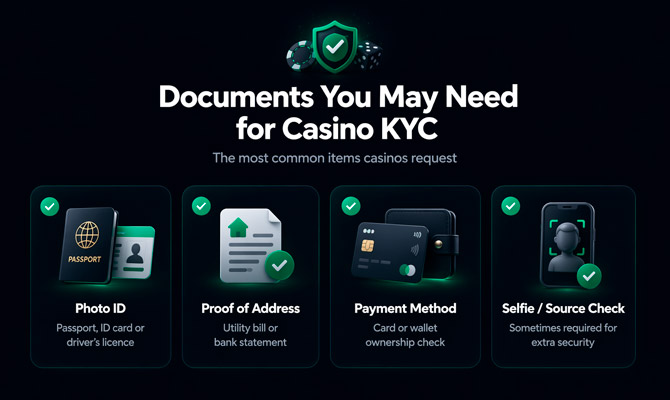
Most operators request three categories of proof, though exact requirements vary by jurisdiction and payment method. Here’s what each one means and which documents work best.
1. Proof of Identity (POI)
A valid, unexpired government-issued photo ID that shows your full name, date of birth, and photo. The document must be legible and show all four corners.
Best option: Passport — it’s standardised globally, contains biometric data, and is accepted everywhere. Driver’s licences and national ID cards also work, but you’ll usually need to upload both sides.
Not accepted: Student IDs, employer badges, expired documents, screenshots of digital IDs (unless the operator explicitly says otherwise).
2. Proof of Address (POA)
A document showing your full name and residential address, dated within the last 90 days. This confirms you live where you say you do and helps the casino comply with jurisdictional restrictions.
What works: Utility bill (electric, gas, water, internet), bank statement, credit card statement, government letter, tax document. Digital PDFs from online banking are usually preferred over photos of paper bills.
What doesn’t work: Mobile phone bills (rejected at some sites), documents older than 90 days, anything with a PO Box instead of a residential address, or documents where the name doesn’t match your casino account exactly.
3. Proof of Payment Method
This confirms that the deposit method actually belongs to you.
For cards: A photo of the front of your card showing your name and the last four digits. Cover the middle 8 digits and the CVV on the back — the casino only needs to match the card to your account, not access your full number.
For e-wallets: A screenshot of your account page showing your name and registered email.
For crypto: Requirements vary more than for fiat methods. If you deposited from a centralised exchange (Binance, Coinbase, Bybit), operators commonly ask for a screenshot of your exchange profile page (showing your name/email) and the withdrawal history showing the specific TxID that matches the deposit. If you deposited from a non-custodial wallet (MetaMask, Trust Wallet), they may ask for a screenshot of the wallet’s transaction detail page. Some operators accept a signed message from your wallet address as ownership proof. A generic screenshot of a wallet balance is rarely sufficient.
Bonus: Source of Funds (SoF) and Enhanced Due Diligence (EDD)
These are triggered less often but can catch players off guard. If you make a large deposit, win a significant amount, or are flagged as a high-value player, the operator may ask you to prove where your money comes from.
What they want: Recent payslip, employment letter, tax return, bank statements showing salary deposits, proof of property sale, or inheritance documentation. This isn’t about being intrusive — it’s a legal obligation under AML rules, and failing to provide it can freeze your account.
Bonus: Liveness Check (Selfie Video)
Increasingly common in 2026, especially at UKGC and MGA operators. A simple selfie holding your ID is often no longer sufficient. Many compliance systems now require a short video (5–10 seconds) where you hold your ID next to your face while turning your head or blinking — this proves you’re a real person, not a stolen scan.
Some operators go further: they ask you to hold a sheet of paper in the same frame, with the operator’s name and the current date handwritten on it. Without this, automated systems may reject the submission, adding another 24–48 hour cycle.
Tips: Use natural front lighting (no flash). Keep the camera steady. Make sure the text on your ID is readable in the video. Don’t wear sunglasses or hats. Follow on-screen instructions exactly — if the system says “turn right,” turn right, not left.
How to Pass Verification Fast
The difference between a 30-minute approval and a 72-hour wait is almost always about document quality and preparation. Here’s the step-by-step approach:
Step 1: Verify Immediately After Registration
Don’t wait for your first win or your first payout. Most platforms let you upload documents right after account creation — look for “Verify Account,” “Documents,” or “KYC” in your account settings or cashier section.
By verifying early, you remove the single largest source of payout delays. When you eventually request a cashout, it processes against an already-verified account.
Step 2: Prepare Your Documents in Advance
Before you take photos, make sure you have:
- An unexpired passport, driver’s licence, or national ID
- A utility bill or bank statement dated within the last 90 days
- Your deposit card (if you used one)
Check that the name on every document matches exactly what you entered during registration. Even small differences — a middle name on your ID that you left out of your casino profile, or a slightly different spelling — can trigger a rejection.
Step 3: Take Clear Photos
The most common reason for rejection is document quality. Compliance teams use optical character recognition (OCR) to scan your documents, and blurry images cause automated systems to fail.
- Use good lighting. Natural light works best. Avoid flash — it creates glare on glossy ID cards.
- Show all four corners. The entire document must be visible, uncropped.
- Use a plain, dark background. Place your ID on a solid-colour surface, not a patterned tablecloth.
- Keep the file under 10MB. JPG or PNG format. Some platforms also accept PDF.
- Use colour images. Black-and-white scans are often rejected.
Step 4: Submit and Wait
After uploading, typical approval timelines are:
| Casino Type | Typical Review Time |
|---|---|
| Automated (AI-powered verification) | Minutes to 1 hour |
| Standard manual review | 24–48 hours |
| Thorough compliance (UKGC, MGA) | 24–72 hours |
| First-time at busy offshore operators | Up to 72 hours (some state “up to 5 business days”) |
Check your email after submitting. If a document is rejected, you’ll usually receive a reason — fix the issue and resubmit immediately rather than waiting for another review cycle.
Why Verification Fails (And How to Fix It)
Most rejections aren’t fraud-related — they’re human errors that add unnecessary delays. Here are the most common:
| Rejection Reason | Fix |
|---|---|
| Blurry or glare-affected photo | Retake in natural light, no flash, on a flat dark surface |
| Document expired | Use a current document — anything past its expiry date is automatically rejected |
| Name mismatch | Ensure your account name matches your ID exactly, including middle names and accents |
| Address mismatch | Your POA must show the same address as your account profile. Update your profile or use a different document |
| POA too old | Must be dated within 90 days. Get a current bank statement PDF from your online banking — this is the fastest option |
| Card number fully visible | Cover the middle 8 digits. Operators only need name + last 4 digits to match against your account |
| Cropped corners | The entire document, including all edges, must be visible in the image |
| Wrong file format | Use JPG, PNG, or PDF. Avoid HEIC (iPhone default) — convert it first |
The “No-KYC” Myth
Search for “no-KYC casino” and you’ll find dozens of listicles promoting platforms that claim to let you play and cash out without ever showing ID. This is mostly marketing. Here’s what’s actually happening:
What “No-KYC” Usually Means
No KYC at registration. You can sign up with just an email and start playing immediately. This part is true. But it’s not the same as “no KYC ever.”
Most of these casinos reserve the right — buried in their terms — to request full identity documents at any point: at your first payout, when you cross a monetary threshold, when activity patterns trigger risk flags, or simply at the operator’s discretion. The marketing says “no verification.” The terms and conditions say “we can ask anytime.”
The Real Trade-Offs
Genuinely no-KYC platforms do exist — typically unlicensed, crypto-only casinos that never ask for documents. But they come with material trade-offs:
- No dispute resolution. If the operator withholds your funds, there’s no regulator to complain to. Services like Casino Guru and AskGamblers can mediate, but have no enforcement power over unlicensed operators.
- Weaker fund protection. Licensed operators are generally subject to oversight on how they handle player funds — MGA, for example, requires segregation of player money from operating capital. Unlicensed platforms have no such obligation. If they go bankrupt or shut down, your balance likely goes with them.
- Withdrawal caps. Many “no-KYC” casinos impose tight daily limits ($2,000–$5,000) and monthly caps. Large wins may be paid out over months — if at all.
- Selective enforcement. Some casinos only apply no-KYC status to deposits and small payouts. Win big, and the compliance department suddenly appears.
Our recommendation: treat KYC as a feature, not a bug. A casino that verifies your identity is a casino that’s accountable to a regulator. That accountability is what protects you when things go wrong.
Looking for casinos with fast, smooth verification?
Frequently Asked Questions
What does KYC mean at online casinos?
KYC stands for Know Your Customer. It’s the identity verification process operators use to confirm your name, age, address, and payment method ownership. It’s a legal requirement under anti-money laundering regulations — not a casino policy choice.
What documents do I need for casino verification?
Three things: a valid government-issued photo ID (passport is best), a proof of address dated within 90 days (utility bill or bank statement), and proof of your payment method (card photo or e-wallet screenshot). For large amounts, you may also need Source of Funds documentation like a payslip or tax return.
How long does casino verification take?
It depends on the casino’s system. Automated (AI-powered) checks can approve documents in minutes. Manual review typically takes 24–48 hours. Some casinos state “up to 72 hours” or even “up to 5 business days” in their terms. The biggest factor is document quality — clear, correctly formatted photos are processed faster.
Can I play before completing verification?
At most Curaçao-licensed casinos, yes — you can deposit and play without verifying first. But you won’t be able to cash out until verification is complete. At UKGC and some MGA operators, verification may be required before you can even deposit. Check the casino’s policy at registration.
Why was my verification rejected?
The most common reasons: blurry photos, expired documents, name or address mismatch between your ID and casino account, proof of address older than 90 days, or showing your full card number instead of covering the middle digits. Contact live chat for the specific reason and resubmit corrected documents.
Are no-KYC casinos safe?
It depends on what you mean by “safe.” Genuinely no-KYC casinos skip identity checks, which means faster access — but also no regulatory accountability, no fund segregation, and limited recourse if the casino withholds your funds. Most “no-KYC” casinos also reserve the right to request documents later, especially at larger withdrawals. Read the terms before assuming you’ll never be asked for ID.
What is Source of Funds (SoF) and when is it triggered?
Source of Funds is a deeper check where the operator asks you to prove where your deposit money comes from — payslips, bank statements, tax returns, or proof of sale. It’s triggered by large deposits, significant wins, or when risk systems flag unusual financial activity. The exact thresholds vary by operator and regulator. It’s an AML requirement, not harassment — but it can add days to the process if you’re not prepared.
Further Reading
- Instant withdrawal casinos explained — what “instant” actually means and how verification affects payout speed
- Why casino withdrawals get delayed — common causes beyond verification and how to fix them
- How to check if a casino is legit — 7-point checklist including licence and safety verification
- Curaçao vs MGA licence — how your casino’s licence affects the verification process
- Our scoring methodology — how we evaluate verification speed across our casino pool