
You won $15,000 at an online casino. You go to withdraw and discover you can only take out $5,000 per week. That means three weeks of waiting — three weeks during which the money sits in your casino account, visible and playable, while the platform quietly hopes you will give some of it back. That is not a bug. It is how withdrawal limits are designed to work.
Every online casino sets caps on how much you can withdraw per day, per week, and per month. These limits are buried in the terms and conditions, almost never displayed on the homepage, and they vary dramatically between platforms, payment methods, and player tiers. Understanding them before you deposit is the difference between a smooth cashout and a months-long drip of your own winnings.
Five Types of Withdrawal Limits
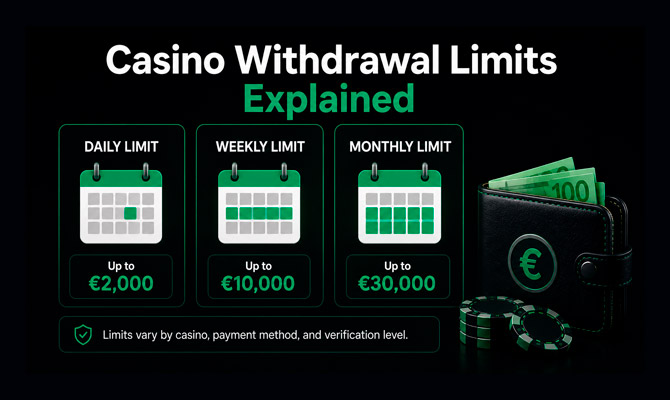
Daily limit
The maximum you can withdraw in a 24-hour period. At most platforms, this ranges from $500 to $5,000 for standard accounts. Crypto-native casinos tend to offer higher daily caps or none at all. This limit affects how quickly you can access a single session’s winnings — if you win $8,000 tonight and the daily cap is $2,000, the remaining $6,000 stays in your account until tomorrow.
Weekly limit
The total you can withdraw in a 7-day window. Typical range: $2,000 to $20,000. This is often the binding constraint for mid-size wins. A $10,000 win at a casino with a $5,000 weekly cap takes two weeks to extract fully. During that time, the funds are exposed to the risk of continued play — a behavioural dynamic the operator is aware of.
Monthly limit
The aggregate maximum over a 30-day period. Standard range: $20,000 to $100,000. Some operators are more restrictive — Galaktika N.V. casinos, for example, typically cap monthly payouts at €80,000–€125,000. This limit primarily affects jackpot winners and high-volume players. A $50,000 win at a casino with a $10,000 monthly cap means five months of scheduled payouts. That is not a withdrawal — it is an installment plan.
Per-transaction limit
The maximum amount for a single cashout request, regardless of daily or weekly caps. Some payment processors impose their own per-transaction ceilings — Apple Pay caps at $10,000, some bank transfers cap at $3,000–$5,000 per transfer. Even if the casino allows $20,000 per week, your payment method may force you to split it into multiple smaller transactions.
Lifetime deposit multiplier
The most aggressive cap — and the one most players never see until it hits them. Some offshore operators (particularly common on SoftSwiss-powered platforms) include a rule like: “Maximum withdrawal is capped at 10× your lifetime deposits.” If you deposited $50 total and hit a $10,000 jackpot, you can only withdraw $500. The remaining $9,500 is forfeited. This rule is buried deep in the T&C and disproportionately punishes low-deposit players who land a big win. Always search for “lifetime” or “cumulative deposit” in the terms before you play.
Typical Ranges by Casino Type
| Casino type | Daily | Weekly | Monthly | Notes |
|---|---|---|---|---|
| Budget / casual | $500–$2,000 | $2,000–$5,000 | $10,000–$20,000 | Tightest caps. Common at small Curaçao operators |
| Mid-range | $2,000–$5,000 | $5,000–$20,000 | $20,000–$50,000 | Most mainstream offshore platforms |
| High-roller / VIP | $5,000–$50,000 | $20,000–$100,000 | $100,000+ | Unlocked through VIP tiers or by request |
| Crypto Tier-1 | No cap or $50,000+ | No cap or $100,000+ | No cap or $500,000+ | Stake (confirmed no max), BC.Game, Roobet |
| Crypto mid-tier | 0.05–1 BTC | $5,000–$40,000 | $20,000–$100,000 | SoftSwiss-powered brands (7Bit, mBit, etc.) |
| US regulated | Varies by state | $10,000–$100,000 | Typically no cap | Licensed operators (DraftKings, BetMGM, FanDuel) |
Ranges are approximate planning benchmarks assembled from public T&C patterns and market observation — not regulator-set standards. Always verify with the specific operator before depositing. Note: UKGC regulations require that withdrawal conditions be “reasonable” and prohibit operators from setting arbitrary maximum limits on the amount players can withdraw. UK-licensed platforms therefore fall outside the offshore ranges above.
Why Withdrawal Limits Exist
Casinos explain limits as cash flow management and fraud prevention. Both reasons are partially true — but the full picture is more complicated.
Cash flow management is real for smaller operators. A casino with a $2 million monthly revenue cannot pay out a $500,000 jackpot in one transfer without risking operational liquidity. Spreading it over months keeps the business solvent. Large operators and crypto-native platforms with substantial reserves face this constraint less, which is why their caps tend to be higher or nonexistent.
Fraud and AML compliance is also legitimate. Unusually large, rapid withdrawals can indicate money laundering, stolen payment credentials, or bonus abuse. Limits create a window for the compliance team to review transactions. Your KYC verification, which we covered in our KYC guide, is part of this process.
Player retention is the unspoken third reason. Money sitting in a casino account is money that might be played. The longer your balance stays on the platform between installment payouts, the higher the probability that you wager some of it. This creates an obvious retention incentive, regardless of whether the formal rationale is liquidity or compliance. We covered related friction points in our guide to why withdrawals get delayed.
What Affects Your Personal Limit
Payment method
Crypto payouts generally offer higher per-transaction ceilings than card or bank withdrawals because there is no intermediary bank imposing its own caps. However, this does not mean all crypto casinos have unlimited payouts — many mid-tier platforms set strict BTC or USDT daily limits that can be tighter than fiat alternatives at larger traditional operators. Switching your payout method (e.g., depositing by card but withdrawing via crypto) can increase your effective ceiling at some platforms, but this is operator-dependent and often constrained by AML/KYC rules that require payout to match the deposit method. For a detailed comparison, see our instant withdrawal guide.
VIP / loyalty tier
Most operator groups run tiered VIP programs that progressively raise your cashout ceiling. A standard player at a mid-range casino might face a $5,000 weekly cap, while a VIP at the same platform withdraws $50,000+ without restriction. Some operators negotiate custom limits for high-volume players on request. If you play regularly and limits matter to you, VIP progression is the most reliable way to raise them.
KYC verification status
Unverified accounts almost always face lower limits than verified ones. Some platforms block all withdrawals until identity documents are approved. Others allow a single small cashout (typically $2,000–$3,000) before requiring full verification for anything larger. Completing KYC early — before you need to withdraw — removes this bottleneck.
Operator group
Limits are set at the operator level, not the brand level. If a casino group caps monthly payouts at €100,000 across their portfolio, every brand in that group carries the same restriction, even if the individual casino’s marketing suggests otherwise.
What to Check Before You Deposit
1. Find the limits page. Check the casino’s T&C (search for “withdrawal limit”, “cashout”, or “maximum payout”) and the banking/payments section. If limits are not clearly stated anywhere, contact support and ask directly. A casino that hides its payout caps is not one you want to deposit at.
2. Calculate your worst case. Ask yourself: if I win my maximum realistic amount (say, a 1,000x slot hit on a $10 bet = $10,000), how long would it take me to withdraw everything at this casino’s caps? If the answer is months, the platform may not be right for your play style.
3. Check per-method limits separately. The casino’s general weekly cap might be $20,000, but your chosen payment method might cap at $5,000 per transaction. Crypto payouts typically avoid this issue. Card and bank payouts are where per-method restrictions most often bite.
4. Confirm whether jackpot wins are exempt. Network progressive jackpots (like Mega Moolah) are paid by the game provider, not the casino — at properly licensed operators, these are typically exempt from standard withdrawal caps and paid in full. Local or casino-specific jackpots, however, are paid from the operator’s own funds and usually remain subject to standard limits. This distinction matters: ask support whether the jackpot games you play are network or local before committing significant stakes.
Our quiz factors in payout limits and withdrawal speed when matching you with casinos. Tell us your priorities and we will filter out platforms with caps that do not fit your play style.
FAQ
Can I increase my withdrawal limit?
Yes, in most cases. VIP and loyalty programs are the primary mechanism — higher tiers unlock higher caps. Some operators also allow custom limit negotiations for high-volume players. Completing full KYC verification typically unlocks the standard maximum. Switching to crypto payouts may also bypass per-method restrictions, depending on the platform.
What happens to money above the limit?
It stays in your casino account until the next withdrawal window opens. If your monthly limit is $10,000 and you have $30,000 in your account, you can withdraw $10,000 this month, $10,000 next month, and $10,000 the month after. The remaining balance is visible and playable throughout that period — which is part of the design.
Do crypto casinos have withdrawal limits?
Some do, some do not. Large crypto-native platforms like Stake and BC.Game typically operate with no hard cap on daily or monthly payouts, processing six-figure amounts without restriction. Smaller operators or those using white-label platforms often do impose caps, sometimes tighter than fiat casinos. Always verify — “crypto casino” does not automatically mean “unlimited payouts.”
Are bonus winnings subject to different limits?
Often, yes. Many bonuses carry a separate “max cashout” cap that is much lower than the casino’s standard withdrawal limit. A no deposit bonus might cap your cashout at $100–$200 regardless of your balance. Deposit match bonuses may also have per-bonus caps. These are in addition to the casino’s standard daily/weekly/monthly limits. We covered this in our no deposit bonus guide.
What if a casino refuses to pay within its own stated limits?
If the platform is not honoring its published payout terms, you have grounds for a formal complaint. Document everything (screenshots of T&C, withdrawal requests, support conversations), then file with a mediation service like AskGamblers or Casino Guru. For licensed operators, you can also escalate to the licensing authority (MGA, Curaçao Gaming Authority). We walk through this process in our guide to what happens when a casino does not pay.
Related
- Instant Withdrawal Casinos Explained — what “instant” actually means
- Why Casino Withdrawals Get Delayed — KYC, bonuses, and hidden clauses
- Casino KYC Guide — how to pass verification faster
- Casino Operator Groups — why sister sites share the same limits