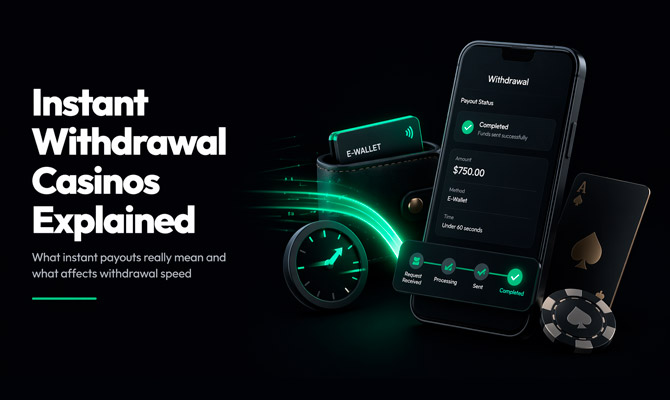

Every casino landing page says “instant withdrawals.” Very few of them mean what you think they mean.
In casino marketing, “instant withdrawal” almost always refers to approval speed, not final receipt. On faster crypto networks, the gap between approval and money-in-wallet can be very short. On cards and bank transfers, it can still mean waiting business days — even though the casino approved your request in seconds.
This article breaks down what actually controls how fast you get paid, which delays come from the payment rail and which come from operator policy, and how to set yourself up so your money moves as quickly as possible.
- “Instant” usually means casino approval, not money-in-hand
- Crypto tends to be fastest end-to-end — but only after KYC and bonus status are clean
- KYC, wagering requirements, and review clauses cause more delays than payment networks
- Card and bank withdrawals are rarely truly instant, regardless of what the casino says
- First-time cashouts take longest — complete KYC before you play
Two Clocks Are Running
When you hit “withdraw,” two separate timers start. Casinos usually quote only the first one.
Clock 1: Casino Processing
This is the internal review. The casino checks your balance, verifies bonus status, runs fraud filters, and releases the funds. At crypto-first platforms with automated hot wallet systems, this can take seconds. At traditional casinos with manual compliance teams, it can take 24–72 hours — and they’re still technically within their stated terms.
The gap between “automated approval” and “human review queue” is where most frustration lives. A casino that processes crypto withdrawals automatically during off-peak hours might queue your request for manual review if you’ve won a large amount, triggered a fraud flag, or haven’t completed KYC.
Clock 2: Network Settlement
Once the casino releases the funds, the payment network takes over. This part is outside the casino’s control — and it varies enormously:
| Method | Typical Settlement | Fees | Notes |
|---|---|---|---|
| USDT (TRC-20) | Seconds to minutes | Network only (~$1) | Usually the fastest stablecoin option |
| Solana (SOL) | Seconds to minutes | Network only (<$0.01) | Very fast; less widely supported at casinos |
| Litecoin (LTC) | ~2–15 minutes | Network only (<$0.05) | First confirmation ~2.5 min; widely accepted |
| Bitcoin (BTC) | 10–60+ minutes | Network only ($1–$10) | ~10 min per block; confirmation requirements vary |
| Ethereum (ETH) | Minutes | Gas fee ($1–$15+) | Varies with congestion; see note below |
| PayPal / Skrill / Neteller | Minutes to 24 hours | Usually free | Fast to wallet; wallet-to-bank adds 1–3 days |
| Visa / Mastercard | 1–3 business days | Rare (check T&C) | Batched settlement; weekends don’t count |
| Bank wire | 3–7 business days | $10–$30 common | Intermediary banks add hops |
Settlement times are typical ranges under normal network conditions. Actual times depend on network congestion, casino confirmation policy, wallet configuration, and withdrawal amount. Fees shown are network/provider fees — most crypto casinos charge zero platform fees on top.
What “Instant” Actually Means by Method
When a casino says “instant withdrawal,” here’s what that realistically means for each payment type:
Crypto: Usually the Shortest End-to-End
Crypto typically offers the shortest total time from approval to receipt, especially on faster networks. At a well-optimised crypto casino with automated hot wallets, the full pipeline — request, approval, broadcast, on-chain confirmation — can complete in minutes for fast-chain coins like USDT on TRC-20 or Litecoin.
Bitcoin is slower by design: the blockchain confirms one block roughly every 10 minutes, and confirmation requirements vary by operator and wallet. Some casinos mark a BTC withdrawal as complete after one confirmation; others wait longer.
One critical detail that catches people: USDT exists on multiple networks. USDT on Ethereum (ERC-20) can become significantly more expensive during congestion — and when gas costs spike, some casinos deliberately delay processing, waiting for fees to drop before broadcasting your transaction. The same USDT on Tron (TRC-20) is typically much cheaper and faster. Always check which network the casino is sending on, and make sure your wallet supports it. Sending to the wrong network can result in permanently lost funds.
E-Wallets: Hours, Sometimes Minutes
PayPal, Skrill, and Neteller sit in the middle. The casino-to-wallet transfer is usually fast — minutes to a few hours. But money sitting in an e-wallet isn’t money in your bank account. If you want cash, you still need to transfer from the wallet to your bank, which adds another 1–3 days depending on the provider.
Cards and Bank Transfers: Days
Debit card withdrawals process through the card network’s settlement cycle. The casino submits a refund or credit, and the network batches it. One to three business days is standard; five is not unusual at weekends. Bank wires go through intermediary banks, each adding processing time.
No casino, regardless of how efficient their internal systems are, can make a Visa network settle faster. Calling a card withdrawal “instant” is technically about the approval step, not the delivery.
Six Things That Slow Withdrawals Down
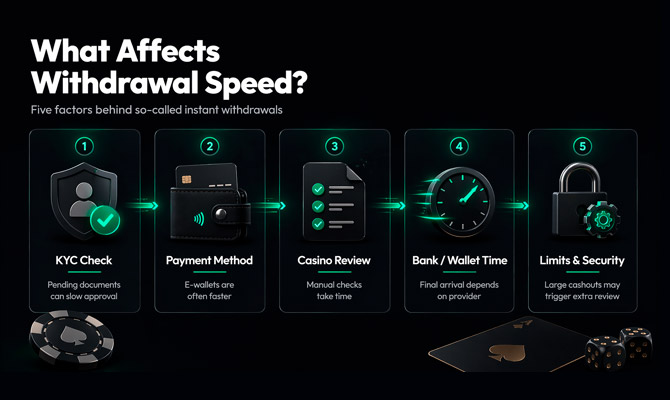
Even at fast casinos, specific conditions can lock your withdrawal in “pending” for hours or days. These are the most common — and the first two hit almost every first-time player.
1. KYC Verification (First Withdrawal or Threshold)
Know Your Customer checks — uploading government ID, proof of address, sometimes a selfie — are often triggered at your first withdrawal or when you cross cumulative withdrawal thresholds (often $2,000–$5,000) at most licensed casinos. If you haven’t completed KYC before requesting a cashout, your withdrawal sits in a queue until verification clears.
Verification timelines vary wildly: some casinos process documents in under an hour; others take 24–48 hours. A few explicitly state “up to 72 hours” in their terms.
2. Deposit Turnover (The AML Trap)
This one blindsides players who skip the welcome bonus, thinking they’re in the clear. Most licensed casinos require you to wager your deposit at least 1–3× before withdrawing — even with no bonus active. This is an anti-money-laundering (AML) requirement, not a bonus condition.
Here’s how it works: you deposit $100 with no bonus. On the first spin, you win $500. You try to withdraw $598 — and the request is rejected. Why? You’ve only wagered $2 of the required $100–$300 in deposit turnover. Until you place enough bets to satisfy the AML rule, your funds are locked. For newcomers, this looks exactly like a scam, but it’s a regulatory requirement that applies at virtually every licensed casino.
3. Unfinished Bonus Wagering
If you accepted a welcome bonus and haven’t met the wagering requirement, your withdrawal will be blocked — or worse, the casino will confiscate the bonus balance and any winnings derived from it.
A 40× wagering requirement on a $100 bonus means you must place $4,000 in total bets before a single dollar becomes withdrawable. At 96% RTP, you’ll statistically lose about $160 of that bonus grinding through the requirement. The math is explained in detail in our bonus wagering breakdown.
Before withdrawing, always check your bonus status in the casino dashboard. If wagering is still active, either complete it or forfeit the bonus before requesting a cashout. Some casinos let you cancel an active bonus; others don’t.
4. Withdrawal Limits
Daily, weekly, and monthly withdrawal caps vary by casino and sometimes by payment method. If you won $15,000 and the daily limit is $5,000, you’ll need three days minimum just to get the money out — assuming every request is approved instantly.
Monthly limits matter even more. In the Galaktika N.V. network (Sol Casino, Jet Casino, Fresh Casino, and others), monthly caps range from €80,000 to €125,000 depending on the brand. Progressive jackpot wins are usually exempt from these limits, but regular wins are not.
5. Weekend Processing and Hot Wallet Depletion
Crypto doesn’t care about weekends — blockchains run 24/7. But fiat payment methods do. Bank transfers submitted on Friday afternoon may not start processing until Monday. Card network batches may skip weekends entirely.
If speed matters and you’re using fiat, submit your payout request on Monday or Tuesday morning. This gives the full business week for processing.
For crypto, a less obvious delay: hot wallet depletion. Casinos hold a limited amount of each cryptocurrency in a “hot wallet” for immediate payouts. If many players withdraw at the same time — say, after a big tournament or promotion — the hot wallet runs dry. The casino then needs to move funds from cold storage or replenish from a treasury wallet, which may require manual intervention and can add hours to your wait. This is more common at smaller operators and during peak periods.
6. The “Review Period” Clause
This is the one most players miss entirely. Many casinos include a clause in their T&C that reserves the right to hold withdrawals for an extended review period — ostensibly for fraud checks and gameplay verification. We cover the most extreme example in the next section.
The 31-Day Review Clause
This pattern isn’t unique to one casino. Search any operator’s T&C for “review,” “verification period,” or “right to withhold” and note the maximum window. Common ranges: 3 days (player-friendly), 7 days (standard), 14 days (aggressive), 31 days (extreme). Anything beyond 7 days is a yellow flag worth factoring into your decision.
How to Speed Up Your First Cashout
Your first cashout is almost always the slowest. Once KYC is cleared and your account has a clean history, subsequent payouts tend to process much faster. Here’s how to get that first one out of the way with minimal friction:
Before You Play
- Complete KYC immediately after registration. Upload ID, proof of address, and any other requested documents. Don’t wait for your first win.
- Read the withdrawal section of the T&C. Look for: processing time, daily/monthly limits, review period clauses, deposit turnover requirements, and any conditions that trigger manual review.
- Decide on a bonus strategy. If you want the fastest possible withdrawal, skip the welcome bonus entirely. Bonus wagering is the single largest delay factor. If you do take a bonus, know exactly what the wagering requirement is and track your progress before requesting a cashout.
When You Withdraw
- Use the same method you deposited with. Most casinos require withdrawals to the same payment source used for deposits. If you deposited with Visa, you’ll withdraw to the same Visa card. Planning to withdraw in crypto? Deposit in crypto.
- Choose the fastest network. If you’re using crypto, faster and cheaper networks (USDT on TRC-20, Litecoin, Solana where supported) will usually get you your funds sooner than Bitcoin or Ethereum. The casino’s processing speed is the same — the difference is in network settlement time and fees.
- Withdraw during business hours on weekdays. This matters for fiat methods, but also for crypto if your cashout gets flagged for manual review — the finance team that handles manual approvals typically works business hours in the casino’s home timezone.
- Don’t split withdrawals unnecessarily. Some casinos process one withdrawal at a time. If you submit three $500 requests instead of one $1,500 request, you may triple the processing time.
Speed, limits, method flexibility — what matters most to you?
Frequently Asked Questions
What does “instant withdrawal” actually mean at online casinos?
It means the casino approves your withdrawal request immediately — no manual review queue. It does not mean the money arrives instantly. After approval, funds travel through a payment network (blockchain, card network, bank), and that network determines the final delivery time. Crypto can settle in seconds to minutes; card withdrawals typically take 1–3 business days.
Which payment method gives the fastest casino withdrawal?
Stablecoins on fast networks (USDT on TRC-20, USDC on Solana) and Litecoin tend to offer the shortest total time — often minutes from request to wallet under normal conditions. Bitcoin works but adds network confirmation time that can stretch to an hour. E-wallets like PayPal are faster than cards but not as fast as crypto; cards take days.
Why is my casino withdrawal stuck on “pending”?
The most common reasons: incomplete KYC verification, an active bonus with unfinished wagering requirements, deposit turnover not met (AML rule), hitting a daily or weekly withdrawal limit, or a security review triggered by unusual account activity. Check your verification status and bonus balance first — those cover the majority of pending withdrawals. See our full guide to withdrawal delays for a troubleshooting walkthrough.
Can a casino hold my withdrawal for 31 days?
Some can, if their terms allow it. Certain operator groups include a clause reserving the right to review withdrawals for up to 31 calendar days — for example, to verify gameplay patterns. This is a contractual maximum, not the norm, but it has been enforced in documented cases. Always read the T&C before depositing and search for “review period” or “right to withhold.”
Do I need to complete KYC before withdrawing?
At most licensed casinos, yes — often triggered at your initial cashout or when you cross cumulative thresholds (typically $2,000–$5,000). Some crypto-native platforms skip KYC for smaller amounts, but any licensed operator under MGA or Curaçao regulations will require identity verification at some point. Complete it immediately after registration to avoid delays later.
Is it faster to withdraw in crypto or fiat?
Crypto usually has a structural speed advantage. The best crypto casinos process the full pipeline — request, approval, on-chain settlement — in minutes. The fastest fiat method (e-wallets) takes hours to a day; cards take 1–3 business days; bank wires take 3–7. Crypto also runs 24/7 with no weekend delays. However, crypto withdrawals can still be slowed by KYC, manual review triggers, or hot wallet depletion — the payment rail is only the last step.
What is the deposit turnover requirement?
An anti-money-laundering rule that requires you to wager your deposit 1–3× before withdrawing, even if you didn’t accept a bonus. This prevents people from using casinos to launder money by depositing and immediately withdrawing. It’s a regulatory requirement at virtually every licensed casino — check the T&C for the exact multiplier before you play.
Further Reading
- Crypto vs traditional casinos — speed, limits, privacy, and volatility risk compared
- Bonus wagering math — why that 200% match might cost you money
- Why withdrawals get delayed — common causes and what to do about each one
- KYC verification guide — documents needed, timeline, and how to pass faster
- Our scoring methodology — how we evaluate withdrawal speed across our casino pool