

The question isn’t really “crypto or traditional” — it’s “what do you gain and what do you lose by choosing one over the other?” Both approaches let you play the same games from the same providers. The difference is in the financial plumbing: how money gets in, how winnings get out, and what happens between deposit and withdrawal.
This article compares the two models using data from our verified pool of 25 casinos, many of which support both crypto and fiat. No hype about “the future of gambling” — just a practical breakdown of what changes for you as a player.
Choose crypto if you care most about payout speed, banking privacy, and global access.
Choose fiat if you care most about regulator-backed recourse, familiar payment rails, and zero wallet management.
Choose stablecoins (USDT/USDC) if you want crypto speed without price volatility — the practical middle ground.
Quick Comparison
| Factor | Crypto Casino | Traditional (Fiat) Casino |
|---|---|---|
| Deposit speed | Minutes (on-chain confirmation) | Instant (card) / 1–3 days (bank wire) |
| Withdrawal speed | Typically minutes to hours | 1–5 business days (faster for e-wallets) |
| Minimum deposit | Often $0–$5 | $10–$20 typical |
| Transaction fees | Network fees (varies by chain and wallet) | Usually free from casino side; bank may charge |
| Privacy | No gambling descriptor on bank statement; exchange records may still exist | Appears on bank/card statement (MCC 7995) |
| Volatility risk | Yes for BTC/ETH; largely removed with stablecoins | No |
| Chargebacks | Irreversible — no chargebacks possible | Chargeback possible through card issuer |
| KYC timing | Often delayed until first withdrawal | Usually required at registration |
| Trust mechanism | Provably fair hashes (for originals); audited RNG (for third-party slots) | Audited RNG (eCOGRA, iTech Labs, GLI) |
| Regulation | Typically offshore (Curaçao, Anjouan) | Ranges from offshore to Tier 1 (MGA, UKGC) |
| Bonus models | Cashback / rakeback common | Deposit match / free spins common |
These are general patterns, not absolutes. Many casinos in our pool support both crypto and fiat — see the hybrid section below.
Deposit & Withdrawal Speed
This is where the difference is most dramatic.
Crypto
A crypto deposit arrives after on-chain confirmation — typically 1–10 minutes depending on the network. Bitcoin can take 10–30 minutes during congestion; USDT on TRC-20 (TRON) usually confirms in under a minute. Withdrawals follow the same pattern: the casino broadcasts the transaction, and your wallet receives it after network confirmation.
In our pool, casinos like Stake, Gamdom, Roobet, and Shuffle typically process crypto withdrawals within minutes for standard amounts. For larger sums or first-time withdrawals, manual review may add delay — but even then, crypto is generally faster than fiat rails.
Fiat
Card deposits are instant — the money appears in your casino balance immediately. But withdrawals reverse: card cashouts take 1–3 business days, bank wires take 3–5 days, and e-wallets (Skrill, Neteller) take 1–2 days. Weekend and holiday processing adds further delay.
The asymmetry is by design. Instant deposits encourage play; slow withdrawals create a window where you might cancel the withdrawal and keep playing. Some casinos exploit this through “pending period” mechanics — a 24–72 hour cancellation window before the withdrawal is even processed.
Minimums & Limits
Crypto casinos typically have lower entry barriers. In our pool:
- $0 minimum: Stake, BC Game (crypto deposits)
- $1 minimum: Gamdom, Shuffle
- $5 minimum: Bitstarz, Winz, Roobet (crypto)
- $10–$20 minimum: Typical for card/bank deposits at most casinos
Withdrawal limits also differ. Crypto-only casinos tend to have higher daily limits (or no stated cap for standard VIP tiers), while fiat-focused casinos often cap at $1,000–$5,000/day for lower tiers. VIP programs raise these limits across both models.
Network fees are the one area where fiat sometimes wins. Sending $10 in BTC can cost $1–$5 in fees (depending on congestion), eating 10–50% of a micro-deposit. USDT on TRC-20 costs under $1. Card deposits are typically fee-free from the casino’s side, though your bank may charge a cash advance fee for gambling transactions.
Privacy & Banking Visibility
This is often the real reason people choose crypto gambling, even if they don’t say it out loud.
Fiat: Every deposit appears on your bank or card statement. The descriptor varies — sometimes the casino name, sometimes a parent company name — but it’s a gambling transaction. This can affect loan applications, insurance assessments, and joint account visibility in some jurisdictions.
Crypto: The transaction exists on-chain (publicly visible if someone knows your wallet address), but there’s no entry on a bank statement. No descriptor, no paper trail through traditional banking, no gambling label attached to your financial history.
For players in jurisdictions where gambling is legal but culturally sensitive, or where banking relationships are affected by gambling transaction history, this distinction is significant.
Volatility Risk — The Hidden Cost of Crypto
This is the factor that crypto-positive articles tend to downplay. If you deposit in Bitcoin and the price drops 10% while you’re playing, your withdrawal is worth 10% less in fiat terms — even if you won at the tables.
Worked example:
- You deposit 0.01 BTC when BTC = $60,000. That’s $600 in value.
- You play for an hour, break even, and withdraw 0.01 BTC.
- During that hour, BTC drops to $54,000.
- Your withdrawal is now worth $540. You “lost” $60 without losing a single bet.
The reverse can also happen — BTC rises and you come out ahead of your gambling results. But you’re adding market speculation on top of gambling, which increases total variance.
The stablecoin solution
USDT (Tether) and USDC largely remove BTC/ETH price volatility during play. Both are designed to track the US dollar 1:1, so your $600 deposit stays near $600 regardless of what Bitcoin does. Most crypto casinos in our pool accept USDT on multiple chains (TRC-20 is typically cheapest for standard transfers).
Stablecoins reduce the biggest crypto-specific risk, but they don’t eliminate all crypto costs. You still face: exchange spreads when buying/selling, network fees that vary by chain and conditions, and the underlying issuer/peg risk (remote, but real — as shown by past stablecoin events).
Hidden costs of the crypto rail
Volatility gets most of the attention, but there are other costs that crypto-enthusiast articles tend to understate:
- Exchange spread. Buying USDT or BTC on an exchange costs slightly more than the market price. Selling costs slightly less. This spread is typically 0.1–0.5% — small but real on every round trip.
- Wrong-chain or wrong-address risk. Sending USDT on ERC-20 to a TRC-20 address (or vice versa) can result in permanently lost funds. Crypto transactions are irreversible. There is no bank to call.
- Self-custody responsibility. If you use a personal wallet (not an exchange), you’re responsible for seed phrases and device security. Lose access = lose funds.
- Tax and accounting. In many jurisdictions, crypto-to-crypto conversions are taxable events. Depending on where you live, gambling with crypto may create additional reporting obligations compared to fiat.
KYC & Verification
KYC (Know Your Customer) exists at both crypto and fiat casinos. The difference is in timing and intensity.
| Aspect | Crypto Casino | Fiat Casino |
|---|---|---|
| When triggered | Often at first withdrawal or at threshold amounts | Usually at registration or first deposit |
| Documents required | Photo ID, proof of address. Sometimes selfie. | Same, plus payment method verification (card photo/bank statement) |
| Processing time | Hours to days (varies widely) | Hours to days |
| No-KYC play possible? | Yes, at some casinos for small amounts | Rare. Most require KYC before first bet. |
Some crypto casinos allow initial play and smaller transactions without upfront KYC. This is gradually changing as regulators tighten anti-money laundering requirements across jurisdictions, and policies vary significantly by operator and region.
The risk: if KYC is delayed until withdrawal, you might discover verification issues after you’ve deposited and wagered. A casino can request documents at any point, and if you can’t provide them, your funds may be frozen. For a deeper breakdown, see our upcoming article on casino KYC verification.
How Bonus Terms Differ
Crypto and fiat casinos tend to use different reward models:
Fiat-first casinos typically lead with deposit-match bonuses: “100% up to $500, ×40 wagering.” The economics of these offers depend on the wager multiplier, contribution rules, and cashout caps — see our bonus math breakdown for the full analysis.
Crypto-first casinos tend toward cashback, rakeback, or zero-wager models. Stake uses rakeback (percentage of wagers returned). Gamdom and Roobet use cashback (percentage of losses returned). Winz offers zero-wager free spins. These models avoid the complexity of wagering requirements and let you withdraw rewards without conditions.
Hybrid casinos (Bitstarz, BC Game, Fairspin) typically offer traditional welcome bonuses regardless of deposit method. The bonus terms don’t change whether you deposit in BTC or via Visa — the wagering requirement is the same.
Regulation & Player Protection
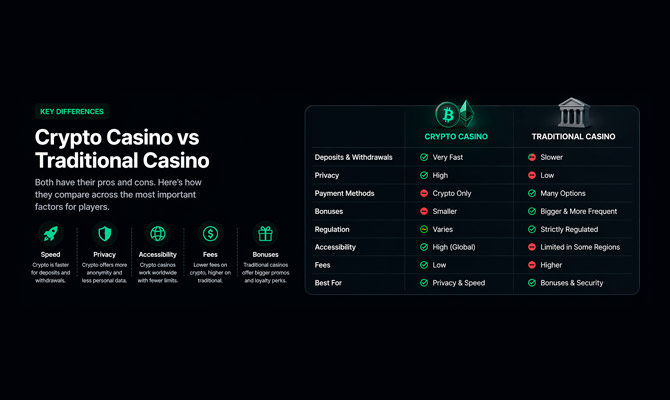
This is the most important trade-off — and the one that gets the least honest discussion.
Fiat casinos with Tier 1 licenses (UKGC, MGA, Ontario) offer strong player protections: mandatory complaint resolution, player fund segregation, responsible gambling tools, and regulated advertising. If a casino doesn’t pay you, you have a regulatory body to escalate to.
Crypto casinos typically operate under Curaçao (CGA), Anjouan, or similar offshore licenses. These jurisdictions do have regulators and licensing frameworks, but practical enforcement and player recourse are weaker than at Tier 1 authorities. If a dispute arises, your options are primarily third-party mediation through platforms like Casino Guru or AskGamblers, rather than formal regulatory complaint processes.
This is why our Trust Floor exists. We require a minimum Casino Guru Safety Index of 7.0/10 specifically because offshore licensing alone provides insufficient player protection. The Safety Index functions as a useful external risk signal — not a replacement for regulation, but a practical screening tool in the absence of strong enforcement.
Provably Fair: Crypto’s Unique Trust Mechanism
One area where crypto casinos offer something fiat casinos genuinely cannot: provably fair gaming.
Traditional casinos rely on third-party RNG audits (eCOGRA, iTech Labs, GLI) — you trust that an external lab verified the “black box” of the random number generator. You can’t verify individual game outcomes yourself.
Many crypto casinos offer provably fair games — primarily their proprietary originals (Crash, Dice, Plinko, Mines). These use cryptographic hash chains: the casino commits to a result before you bet, and after the round you can mathematically verify that the outcome wasn’t altered. It’s not trust-based — it’s math-based.
This applies only to in-house originals. Third-party slots from providers like Pragmatic or NetEnt use standard RNG regardless of whether the casino is crypto or fiat. But for players who primarily play originals, provably fair verification is a meaningful trust advantage that no fiat-only casino can match.
Hybrid Casinos: The Middle Ground
Many casinos in our pool aren’t purely crypto or purely fiat — they support both. This gives you flexibility to choose based on the transaction:
- Deposit via card when you want instant, no-fee deposits without buying crypto first
- Withdraw via crypto when you want fast payouts without waiting for bank processing
- Use stablecoins when you want crypto speed without volatility risk
Hybrid casinos from our verified pool include Bitstarz, BC Game, Fairspin, Winz, 1xslots, Play Fortuna, and most Galaktika N.V. brands (Jet, Fresh, Sol, etc.).
Crypto-only casinos (no fiat withdrawal option) include Gamdom, Roobet, and Shuffle.
Not sure whether crypto or fiat suits your play style?
Take the quiz — withdrawal method is one of our 4 matching questions →
We match you based on payment preference, bonus type, game selection, and deposit range.
Who Should Choose Crypto?
- You want fast withdrawals — minutes, not days
- You want privacy from your bank or card issuer
- You already hold crypto and don’t want to convert to fiat
- You play at offshore casinos where banking options are limited or blocked
- You prefer cashback/rakeback over traditional bonus structures
Who Should Stay With Fiat?
- You don’t own crypto and don’t want to learn the process
- You want chargeback protection through your card issuer
- You play at Tier 1 regulated casinos (MGA, UKGC) and want maximum player protection
- You want zero volatility risk on your deposits (or don’t want to use stablecoins)
- You prefer deposit-match bonuses with clear wagering terms
Frequently Asked Questions
Is crypto gambling safer than regular online gambling?
“Safer” has two meanings here. Crypto transactions are technically secure (blockchain is immutable). But crypto casinos typically operate under weaker licenses than Tier 1 fiat casinos (MGA, UKGC), which means less regulatory recourse if something goes wrong. The transaction is safe; the regulatory protection may not be. Our Trust Floor helps bridge that gap.
Can I avoid volatility risk when gambling with crypto?
Yes. Use stablecoins — USDT or USDC. These are pegged 1:1 to the US dollar. Your $100 deposit stays worth $100 regardless of Bitcoin or Ethereum price movements. USDT on TRC-20 (TRON) is the cheapest option: under $1 in fees and confirmation in under a minute.
Do crypto casinos have better bonuses than fiat casinos?
Not necessarily “better” — but different. Crypto-first casinos tend toward cashback and rakeback (simpler, no wagering requirements). Fiat-first casinos tend toward deposit matches (larger headline numbers but require ×30–40+ wagering). Neither model is universally superior — it depends on your play volume and tolerance for bonus complexity. Our bonus math article explains the trade-offs in detail.
Will my bank block a gambling deposit?
Some banks and card issuers decline gambling transactions, especially in jurisdictions where online gambling is restricted. This is one of the practical reasons players switch to crypto — it bypasses the card issuer entirely. However, gambling with crypto doesn’t change the legality in your jurisdiction. Check your local laws regardless of payment method.
What’s the cheapest way to deposit at a crypto casino?
USDT via TRC-20 (TRON network) is typically one of the cheapest options, with fees often under $1 for standard transfers. Litecoin (LTC) is also inexpensive. Some casinos now accept deposits via Layer-2 networks (Polygon, Arbitrum) with similarly low fees. Bitcoin fees vary with network congestion ($1–$10). Ethereum mainnet (ERC-20) is usually the most expensive option. Actual costs depend on network conditions and wallet implementation at the time of transfer.
Can I deposit with a card and withdraw in crypto?
Generally no. Anti-money laundering (AML) regulations require most casinos to enforce “closed-loop” policies: you must withdraw using the same method you deposited with, at least up to the deposit amount. Depositing via Visa and immediately withdrawing to a crypto wallet is a classic money laundering pattern, and legitimate casinos will block it or require extensive source-of-funds verification. If you want crypto payouts, deposit in crypto from the start.
Further Reading
- Casino bonus math — understand the real cost of deposit-match vs cashback models
- How to verify any casino — our 7-point checklist
- Crypto casino quiz — find the right crypto casino for your preferences
- Casinos like Stake — 5 crypto alternatives compared
- Our scoring methodology — how we evaluate casinos across payment methods, safety, and more