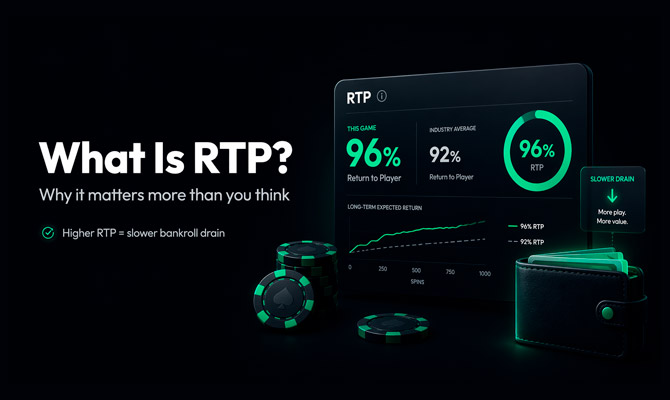

Every slot game has a number that tells you, over the long run, how much of your money the game keeps and how much it gives back. That number is RTP — Return to Player. It’s usually buried in the help menu, and most players never check it. This is a mistake, because RTP is the single variable that determines how fast your bankroll drains.
A 96% RTP slot and a 92% RTP slot might look identical on screen. Same theme, same bonus round, same excitement. But the 92% slot takes twice as much of your money per bet. Over a hundred spins, that difference is invisible. Over a thousand, it’s the difference between a session that lasts and one that doesn’t.
RTP = the percentage of all wagered money a slot returns to players over millions of spins. A 96% RTP means the game pays back $96 for every $100 wagered — and keeps $4 (the house edge). Higher RTP = slower bankroll drain = more play for your money. But RTP only tells you how much comes back, not how — that’s volatility’s job.
What RTP Actually Means
RTP stands for Return to Player. It’s expressed as a percentage — typically between 85% and 99% for online slots. The formula is straightforward:
RTP = (Total returns to players ÷ Total wagers) × 100%
Example: A slot processes $10,000,000 in total wagers across all players and pays back $9,600,000 in winnings. RTP = ($9,600,000 ÷ $10,000,000) × 100 = 96%.
The remaining percentage — 100% minus RTP — is the house edge. A 96% RTP slot has a 4% house edge. This is the operator’s built-in profit margin on every bet placed.
Three things to understand immediately:
RTP is calculated over millions of spins, not your session. In 50 spins, anything can happen. You might double your money on a 90% RTP slot or lose everything on a 99% RTP slot. RTP only becomes meaningful at scale — it describes the game’s long-term mathematical behaviour, not your afternoon.
Every spin is independent. The game doesn’t “know” it owes you money. A slot that hasn’t paid out in 200 spins is not “due” for a win. The Random Number Generator (RNG) produces each result independently of all previous results. There is no memory, no cycle, and no pattern.
RTP applies to the collective, not to you personally. If 10,000 players each wager $100 on a 96% RTP slot, the game will return approximately $960,000 of the $1,000,000 total. But some of those players will win $500 and others will win $0. The percentage describes the pool, not any individual session.
RTP and House Edge: Two Sides of the Same Number
RTP and house edge are complements — they always add up to 100%. If you know one, you know the other:
| Game | RTP | House Edge | What You Lose Per $100 Wagered |
|---|---|---|---|
| Mega Joker (NetEnt) | 99.0% | 1.0% | $1.00 |
| Blood Suckers (NetEnt) | 98.0% | 2.0% | $2.00 |
| Gates of Olympus (Pragmatic) | 96.5% | 3.5% | $3.50 |
| Industry average slot | 96.0% | 4.0% | $4.00 |
| Sweet Bonanza (reduced config) | 93.0% | 7.0% | $7.00 |
| European Roulette | 97.3% | 2.7% | $2.70 |
| Blackjack (basic strategy) | 99.5% | 0.5% | $0.50 |
The table makes the scale clear. The difference between a 96% and a 93% RTP slot is not 3% — it’s a 75% increase in the house edge (from 4% to 7%). Over $1,000 in wagers, that’s an extra $30 taken from your bankroll. Over $10,000 in wagers (easily reached in a single session at $2 per spin), it’s $300.
RTP vs Volatility: The Two Variables That Define a Slot
RTP tells you how much comes back. Volatility (also called variance) tells you how it comes back.
Low volatility + 96% RTP: Frequent small wins. Your balance stays relatively stable, ticking down slowly. You’ll rarely hit a big payout, but you’ll also rarely see your balance vanish in 20 spins. Example: Starburst.
High volatility + 96% RTP: Long dry stretches punctuated by occasional large payouts. Your balance can swing wildly within a session. The 96% RTP is the same, but your experience of it is completely different — you’ll feel like you’re losing most of the time, then one bonus round pays back a session’s worth of losses (or doesn’t). Example: Mental (Nolimit City).
Both games return 96% to players over millions of spins. But the player who needs steady entertainment from a limited bankroll should pick the low-volatility option, and the player chasing a life-changing multiplier should pick the high-volatility option. Same RTP, different experiences, different bankroll requirements.
The Hidden Problem: Operators Choose Which RTP to Run
This is the section most RTP guides skip — and it’s arguably the most important one for your wallet.
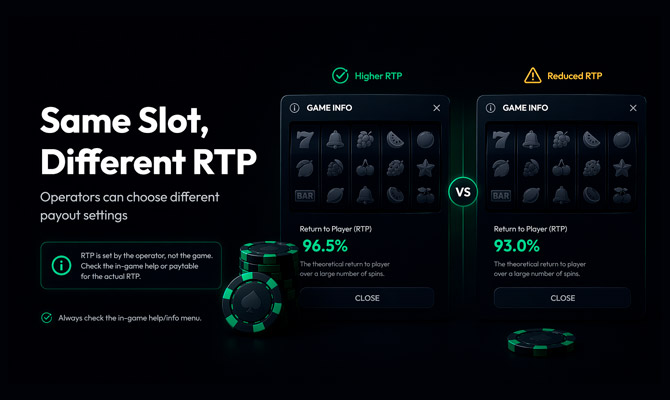
Most major game providers offer operators a choice of RTP configurations for each slot. The provider builds the game with multiple mathematical models — typically a default version and one or more reduced versions. The operator selects which version to run in their lobby.
A concrete example: Pragmatic Play’s Sweet Bonanza is published with a default RTP of 96.48%. But operators can also choose to run it at 95.45%, 93.48%, or even lower. The visuals, sounds, and gameplay are identical across all configurations. The difference is entirely in the underlying math — how often and how much the game pays.
How to check which version you’re playing
Open the game, find the help/info menu (usually a “?” or “ℹ” icon in the game’s interface), and look for the RTP disclosure. The number shown there is the actual RTP for that game at that specific operator — not the provider’s default. If it’s lower than what the provider publishes on their official website, the operator has selected a reduced configuration.
If you can’t find an RTP disclosure in the game’s help file at all, treat that as a yellow flag. Transparent operators make this information easy to find. Its absence may indicate that the operator is less forthcoming about the math underlying their games.
What Counts as Good, Average, and Bad RTP
| Category | RTP Range | House Edge | Assessment |
|---|---|---|---|
| High RTP | 97%+ | Below 3% | Best long-term value. Few games in this range. |
| Above average | 96–97% | 3–4% | Standard for quality slots at default config. |
| Average | 95–96% | 4–5% | Acceptable. Common at reduced-RTP operators. |
| Below average | 93–95% | 5–7% | Significantly worse value. Check if reduced config. |
| Low RTP | Below 93% | Above 7% | Poor value. Avoid unless the game has a unique feature you specifically want. |
Most online slots from major providers are published at 96–96.5% RTP in their default configuration. Anything consistently below 95% at an operator’s lobby deserves scrutiny — it may indicate that the operator has selected reduced RTP versions across their catalogue.
Three RTP Myths That Cost Players Money
Myth 1: “The slot is due for a payout”
No. Each spin is generated independently by the RNG. A slot that hasn’t paid out in 500 spins has exactly the same probability of paying on spin 501 as it did on spin 1. There is no debt, no cycle, and no compensation mechanism. RTP is an emergent property of the math model, not a rule that the game enforces on a spin-by-spin basis.
Myth 2: “Higher RTP means I’ll win more in my session”
Not necessarily. RTP describes what happens over millions of spins. In a 200-spin session, volatility has a far bigger impact on your outcome than RTP does. A high-volatility 97% RTP slot can easily produce a worse session than a low-volatility 94% RTP slot. RTP is a long-term edge, not a session predictor.
Myth 3: “All casinos run the same RTP for a game”
False. As explained above, operators choose from multiple RTP configurations. The same game at two different operators can have meaningfully different RTPs. Always check the in-game help file at the specific operator you’re playing — don’t assume the provider’s published default applies everywhere.
Want to run the numbers yourself? Our partner site has free RTP and house edge calculators.
Our quiz matches you with operators from our verified pool. We factor in game selection and bonus terms — RTP transparency included.
FAQ
What does RTP stand for?
Return to Player — the theoretical percentage of all wagered money that a game returns to players over millions of spins. A 96% RTP means $96 returned for every $100 wagered over the long run.
Does higher RTP mean I’ll win more?
Over the long term, yes — a higher RTP means a lower house edge, so your bankroll drains more slowly. In any single session, however, volatility has a larger impact on your results than RTP. Higher RTP gives you better odds, not guaranteed wins.
Why do some casinos show a different RTP for the same slot?
Most providers offer operators multiple RTP configurations for each game. The operator selects which version to run. Lower RTP = higher revenue for the operator. Check the in-game help file for the actual RTP at your specific operator.
What is the difference between RTP and volatility?
RTP tells you how much comes back to players over millions of spins. Volatility tells you how it comes back — in frequent small wins (low volatility) or rare large payouts (high volatility). Both metrics are important; they describe different dimensions of the same game.
Where can I find a slot’s RTP?
Open the game, look for a help/info icon (usually “?” or “ℹ”), and find the RTP disclosure in the game rules or paytable section. The number shown is the actual RTP at that specific operator. Some casino lobbies also display RTP alongside each game tile, though this feature is not universal.
Is a 94% RTP slot bad?
It’s below average for online slots. A 94% RTP means a 6% house edge — 50% higher than the industry standard 4%. Over $1,000 in wagers, you’d expect to lose $60 instead of $40. Whether that’s “bad” depends on context: if the game has a unique mechanic you value, the higher cost may be acceptable. But if equivalent games exist at 96%+, the 94% version is objectively worse value.
Related
- Casino Bonuses Explained — how RTP affects wagering costs
- Free Spins: What 200 Free Spins Are Worth — EV calculations for spin offers
- How to Find Casinos by Game Provider — why the same game has different RTP at different operators
- GamblingCalc — free RTP, house edge, and EV calculators