

Most casino review pages list bonuses as if bigger always means better. A 200% match sounds twice as good as 100%. Mathematically, that’s often wrong.
The real value of a casino bonus depends on the wagering requirement, contribution rules, cashout caps, and bonus structure. When you run the numbers, some “generous” offers cost you money out of your own deposit. This is a breakdown of how that works — and when refusing a bonus is the smarter move.
- ×25 or below: Often competitive under favourable terms
- ×25–×35: Depends on RTP, contribution, caps, and expiry
- ×35–×40: Usually weak unless other terms are unusually good
- ×40+: Poor value in most cases — needs full T&C review
- Zero-wager (cashback/rakeback): Generally the best deal for regular players
These thresholds assume wager on bonus only, 96% RTP, 100% slot contribution, no max cashout. If any of those conditions differ, the real value shifts — see below.
Terms vary by operator and can change without notice. Always verify the current T&C before opting in.
What Is a Wagering Requirement?
When a casino gives you a bonus, it comes with a condition: you must bet a certain multiple of the bonus (or bonus + deposit) before you can withdraw any winnings. This multiplier is the wagering requirement.
A ×35 wager on a $100 bonus means you need to place $3,500 in total bets before the bonus converts to withdrawable cash. You don’t need to win $3,500 — you need to wager $3,500. Every spin counts toward the total, win or lose.
The marketing emphasises the bonus size, while the real cost sits in the T&C. “Get $500 free!” sounds great. “$500 that requires $17,500 in bets before withdrawal” sounds different. Both describe the same offer.
The Core Formula
Where:
- Required Wagering = bonus amount × wager multiplier (if wager is on bonus only)
- House Edge = 1 − RTP. For a 96% RTP slot, house edge = 4%
- Required Wagering increases if contribution is less than 100% or if wager applies to bonus + deposit
This formula gives you the expected value — what happens on average across many players. Individual sessions vary wildly due to slot volatility, but the math holds over time.
The Real Cost: Three Scenarios
All examples below: $100 deposit, 100% match bonus, wager calculated on bonus only, 96% average slot RTP, 100% slot contribution, no max cashout.
| Wager | Total Bets Needed | Expected Loss (4% Edge) | Net Value of $100 Bonus |
|---|---|---|---|
| ×25 | $2,500 | $100 | ≈ Break even |
| ×35 | $3,500 | $140 | −$40 loss |
| ×40 | $4,000 | $160 | −$60 loss |
| ×50 | $5,000 | $200 | −$100 loss |
At ×40: you receive $100 in bonus, but the wagering costs you ~$160 in expected losses. On average, you’ll end up with roughly $40 left from your original $100 deposit. The bonus cost you $60 of your own money.
At ×50: your expected loss ($200) exceeds your entire starting balance ($200 = deposit + bonus). You are mathematically paying the casino for the illusion of having a larger balance.
The Four Factors That Break the Math
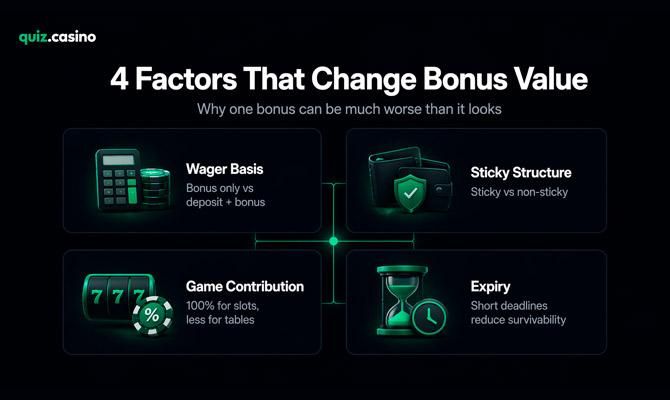
The scenarios above are clean examples. Real bonuses have complications that change the numbers — usually in the casino’s favour.
1. Bonus-Only vs Bonus + Deposit (D+B) Wagering
This is the most common source of confusion. Some casinos calculate the wager on the bonus amount only. Others calculate it on deposit + bonus combined.
The difference is enormous:
| Wager Basis | Deposit | Bonus | Wager ×30 | Total Bets |
|---|---|---|---|---|
| Bonus only | $100 | $100 | $100 × 30 | $3,000 |
| Deposit + Bonus | $100 | $100 | $200 × 30 | $6,000 |
A ×30 wager on D+B requires $6,000 in bets — effectively a hidden ×60 on the bonus itself. This is the most frequent reason a player’s mental math doesn’t match reality. Always check whether the T&C says “wagering applies to the bonus” or “wagering applies to the bonus and deposit.”
2. Sticky vs Non-Sticky Bonuses
This distinction fundamentally changes the bonus economics, and most review sites skip it entirely.
Sticky (standard): Your deposit and bonus funds mix immediately. Wagering activates from the first spin. You play with the combined balance, and the wagering requirement must be completed before any withdrawal.
Non-sticky (also called “parachute” or “forfeitable”): You play with your real deposit first. If you win enough to satisfy yourself, you can cancel the bonus and withdraw your real-money winnings with no wagering. The bonus only activates if your real balance hits zero — it acts as a safety net.
A non-sticky bonus can have positive expected value even at ×40, because it functions as free insurance: if you win early on your own money, you walk away clean. If you lose everything, you get a second chance with bonus funds. The “skip everything above ×35” rule does not apply to non-sticky structures.
3. Game Contribution
Not all games count equally toward wagering. Most casinos use a contribution table:
- Slots: 100% ($1 bet = $1 toward wagering)
- Table games (blackjack, roulette): 10–20%
- Live casino: 10–15%
- Specific high-RTP slots: 0% (excluded entirely)
If you bet $100 on blackjack at 10% contribution, only $10 counts toward wagering. To clear a ×40 wager on a $100 bonus through blackjack alone: $4,000 ÷ 10% = $40,000 in bets. Ten times more than slots.
Many casinos also forbid specific high-RTP slots while a bonus is active — games like Blood Suckers (98% RTP), Dead or Alive, or Mega Joker (99% RTP). If you spin a restricted game even once, some casinos can void all bonus winnings. Always check the “Restricted Games” list in the T&C before you play.
4. Expiry and Survivability
Most bonuses expire in 7–30 days. This isn’t just an administrative detail — it directly affects whether you can complete the wagering.
A ×40 wager on a $100 bonus requires $4,000 in bets. At $5 max bet per spin, that’s 800 spins minimum. At roughly 10 seconds per spin, that’s over 2 hours of continuous play just to complete wagering — assuming you never run out of balance. With a 7-day expiry, casual players who play 20 minutes per session may not finish in time.
Short expiry + high wagering + low max bet = a bonus that’s nearly impossible to clear without dedicated grinding sessions.
Bonus Types: How They Actually Compare
Welcome Bonus (Deposit Match)
The most common type. You deposit, casino matches a percentage. Value depends on the wager multiplier, basis (bonus vs D+B), sticky/non-sticky structure, and cashout caps. See the table above for expected value calculations.
No-Deposit Bonus
A small amount ($5–$25) or free spins given without requiring a deposit. Always comes with wagering — often higher than deposit bonuses (×40–60). Max cashout is typically capped at $50–$100. This is a trial mechanism, not a profit source. Treat it accordingly.
Cashback
The casino returns a percentage of your net losses (e.g., 10% weekly). The best cashback offers credit real money with no wagering attached — but this isn’t universal. Some operators, particularly multi-brand networks, attach ×3 to ×10 wagering to cashback. Always verify whether the credited amount is “real balance” or “bonus balance” in the T&C.
Rakeback
Similar to cashback but calculated on total wagers, not losses. A 1% rakeback on $10,000 in bets returns $100 regardless of outcome. Common at crypto casinos. Most rakeback programs credit without wagering — but like cashback, check for hidden conditions.
Zero-Wager Free Spins
Rare. Winnings go directly to your real-money balance with no playthrough. The amounts are smaller than match bonuses, but every dollar won is genuinely yours. In our verified pool of 25 casinos, Winz is the primary example of this model.
Max Bet and Max Cashout
Max Bet Restriction
Most bonuses set a maximum bet limit while wagering — typically $5 per spin. Exceeding this by even $1 on a single spin can be grounds to void bonus winnings under some T&Cs. This rule prevents high-variance clearing strategies. Set your bet to $5 or below and don’t adjust it until the bonus is fully cleared.
Max Cashout Cap
Some bonuses limit total withdrawable winnings. A $500 bonus with a $500 max cashout means that even a $10,000 jackpot yields only $500 in profit. This cap is most common on no-deposit bonuses and free spins, but appears on deposit matches too. Check for “maximum withdrawal from bonus” or “max cashout” in the T&C before opting in.
The 5-Question Checklist
Before activating any bonus, answer these questions:
- What is the wagering requirement — and is it on bonus only or bonus + deposit? Below ×30 on bonus only is competitive. ×30 on D+B is effectively ×60.
- What games count at 100%? Check contribution table and restricted games list.
- Is there a max cashout? Anything below 10× the bonus amount is restrictive.
- Is the bonus sticky or non-sticky? Non-sticky changes the value calculation entirely.
- When does it expire? 7 days at ×40 with $5 max bet may be unrealistic for casual play.
If the answers show ×40+ sticky wager on D+B with a low cashout cap and 7-day expiry — skip the bonus entirely. Deposit without opting in and play with your own money, no restrictions.
The Alternative: Play Without a Bonus
This is the option that many review pages don’t discuss. You can deposit and play without activating any bonus offer.
No wagering requirements, no max bet limits, no max cashout caps, no contribution tables, no expiry. Every dollar you win is immediately withdrawable. If you hit a 5,000× win on your second spin, you cash out the full amount.
For casual players who deposit $20–$50 and play recreationally, skipping the bonus often provides a better experience than accepting a match that costs more in expected wagering losses than it’s worth.
Not sure which bonus model fits your style?
Our quiz matches you with casinos based on your bonus preference, deposit range, and game type.
Frequently Asked Questions
Is a 200% casino bonus better than 100%?
Not necessarily. A 200% bonus with ×50 wagering on D+B is often worse than a 100% bonus with ×25 on bonus only. The match percentage is just the headline — the wagering requirement, basis, and cashout cap determine the real value. Always calculate the expected wagering cost before comparing offers.
What is a good wagering requirement?
Under favourable conditions (bonus-only basis, 96% RTP slots, 100% contribution, no max cashout), ×25 or below typically offers positive expected value. ×30–35 is roughly break-even. Above ×40 usually costs you money. But these thresholds shift significantly if wagering is on deposit + bonus, contribution is reduced, or max cashout applies.
What does “sticky bonus” mean?
A sticky bonus combines your deposit and bonus funds immediately. You play with the mixed balance and must complete wagering before withdrawal. A non-sticky (forfeitable) bonus lets you play with your real deposit first — you can cancel the bonus and withdraw real-money winnings anytime. Non-sticky bonuses can be worth taking even at higher wager levels.
What does 10% game contribution mean?
It means only 10% of each bet counts toward the wagering requirement. A $10 blackjack bet at 10% contribution adds only $1 to your wagering progress. You’d need 10× more in total bets to clear the same requirement compared to slots at 100% contribution.
Is it better to play without a casino bonus?
For many casual players, yes. Without a bonus, there are no wagering requirements, no max bet limits, no cashout caps, and no expiry. Every win is immediately withdrawable. If the available bonus has a ×40+ sticky wager with restrictive terms, declining it and playing with your own funds is often the better value.
Is cashback better than a welcome bonus?
Often, yes — if the cashback is credited without wagering requirements. Genuine no-wager cashback returns real, withdrawable money. A 10% cashback on $200 in losses returns $20 you can withdraw immediately. Compare that to a $200 welcome bonus with ×40 wagering ($8,000 in bets needed, ~$320 in expected losses). However, some operators attach ×3–10 wagering even to cashback — always check the terms.
Further Reading
- How we score casinos — our full scoring methodology, including how bonus terms affect rankings
- How we verify casinos — the 6-step process behind our Trust Floor
- Casino Guru: How Wagering Requirements Work — independent third-party explainer
- BeGambleAware — support and resources for responsible gambling