

Slots and RNG table games run at your own pace — no one is watching, no timer is running, and you can spin whenever you want. Live casino is different. A real human dealer is on camera, other players are at the same table, and the game moves forward whether you’re ready or not.
If you’ve never played live dealer games, this guide covers what’s actually different, which games are easiest for a first session, and the practical things nobody tells you until you’re already sitting at a virtual table.
Live casino games are streamed in real time from professional studios with physical cards, wheels, and dice operated by trained dealers. The results are real — not generated by software. You see the card dealt, the wheel spinning, the ball landing. The trade-off: you play on the dealer’s schedule, not yours. Rounds have fixed betting windows, minimum bets are higher than RNG games, and true live tables typically have no free demo mode — you need real money to play.
How Live Casino Actually Works
When you click on a live game in the casino lobby, your browser opens a video stream from a studio operated by the game provider — most commonly Evolution, Pragmatic Play Live, or Ezugi. The dealer is real, the equipment is physical, and the outcome is determined by the same mechanics as a land-based casino: a shuffled shoe of cards, a spinning roulette wheel, real dice.
Your interface overlays the video stream with digital betting controls. You place bets by clicking on the betting area during the designated window. Once the timer closes, no more bets are accepted, and the round plays out on camera. Winnings are calculated automatically and credited to your balance.
The key differences from RNG games:
| Feature | RNG (Software) Games | Live Dealer Games |
|---|---|---|
| Pace | You control the speed | Dealer controls the speed |
| Randomness | Software RNG algorithm | Physical equipment (real cards, real wheel) |
| Minimum bet | Often $0.10–$1 | Typically $0.50–$5 (higher for premium tables) |
| Demo mode | Usually available | Not available — real money only |
| Social element | None | Chat with dealer and other players |
| Betting window | Unlimited (until you click) | Fixed timer (typically 10–20 seconds) |
| Connection dependency | Low — loads once | High — requires stable video stream |
The Best Live Games for Your First Session
Start here: Live Roulette
Roulette is the simplest live game because there are no decisions to make under time pressure. You place your chips on the table layout during the betting window, the dealer spins the wheel, and you either win or lose based on where the ball lands. No strategy to memorize, no cards to evaluate, no other players to interact with unless you want to. The house edge is fixed by the rules (2.70% for European, 1.35% for French La Partage), and the pace is slow — roughly 30 rounds per hour, giving you plenty of time between bets.
Next step: Live Baccarat
Baccarat requires exactly one decision: bet on Banker, Player, or Tie. There’s no strategy — the dealer handles all card-drawing rules automatically. The house edge on the standard Banker bet (1.06% after the 5% commission on wins) is one of the lowest in the casino. Baccarat tables tend to run slightly faster than roulette but are still comfortable for beginners. Avoid the Tie bet (14.36% edge).
When you’re ready: Live Blackjack
Blackjack adds a skill element — you need to decide hit, stand, double, or split for each hand. Under time pressure from the betting window, this can feel stressful if you don’t know basic strategy. The upside: with correct play, blackjack has one of the lowest house edges (0.5%). The downside: making errors under time pressure pushes the effective edge to 2–3%. Learn basic strategy on RNG blackjack first, then transition. For a full breakdown of how the math works, see our House Edge Explained guide.
For entertainment: Game Shows
Evolution’s game-show titles — Crazy Time, Monopoly Live, Dream Catcher, Lightning Roulette — are designed for spectacle, not low house edge. They feature spinning wheels, bonus rounds, multipliers, and an energetic host. The house edge is typically higher than traditional table games (5–15% depending on the specific bet), but the entertainment value is high and no skill or strategy is required. Think of these as live TV you can bet on.
Practical Things Nobody Tells You
The betting window is real
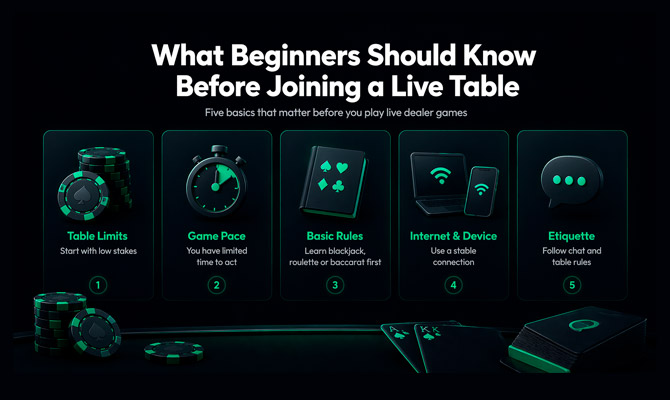
When the timer says 12 seconds, it means 12 seconds. If you don’t place your bet in time, you sit out that round. This feels jarring after the infinite-time comfort of RNG games. It gets better with practice, but for your first session, keep your bets simple — don’t try to place a complex multi-chip roulette layout while the clock ticks down.
Tables can be full
Live blackjack tables have a limited number of seats (typically 7). If a table is full, you wait or choose another. Some providers solve this with “Bet Behind” — you can bet on another player’s hand without sitting down. Roulette and baccarat don’t have this problem because they support unlimited players per table.
Your internet connection matters
Live casino requires a constant video stream. On a weak or unstable connection, the video stutters, the interface lags, and you risk missing the betting window. If your connection drops mid-round, the game continues without you — the dealer doesn’t wait. Your bet stands, and in blackjack the system will automatically stand on your hand (not play basic strategy for you). A stable broadband or strong mobile data connection is a practical requirement, not a nice-to-have.
Chat is optional but monitored
Most tables have a text chat where you can talk to the dealer and other players. Dealers respond to basic greetings and game questions. The chat is moderated — abusive language gets you muted or removed. Using chat is entirely optional; most players don’t.
Minimum bets are higher than you expect
RNG roulette might let you bet $0.10 per spin. Live roulette minimums are typically $0.50–$1 for standard tables and $5–$25 for VIP or premium tables. Live blackjack minimums are commonly $5–$10. Plan your bankroll accordingly — if your budget is $20, a $5-minimum live blackjack table gives you only 4 hands before you’re out (excluding wins).
Who Runs the Live Studios
The studio determines game production quality, table rules, and stream reliability, while the operator still controls access, payments, limits, and account terms. Understanding this split helps you evaluate the experience: a great studio at a poor operator still means slow withdrawals and bad support. The three dominant live providers:
Evolution — the industry standard. Operates the largest studio network worldwide, hosts the widest game variety (blackjack, roulette, baccarat, game shows, poker variants), and supplies the majority of live dealer content across both regulated and offshore markets. If a casino has live games, Evolution is almost certainly among them.
Pragmatic Play Live — the major alternative. Offers a similar range of table games with a distinct visual style. Particularly strong in European and Latin American markets. Often available alongside Evolution at the same operator, giving players a choice of studio aesthetics.
Ezugi — now owned by Evolution, but operates independently. Known for region-specific games and lower-minimum tables. Common at smaller operators and in emerging markets.
Checklist Before Your First Live Session
- Learn the rules first. Play the RNG version of the game (free mode) until you’re comfortable with the mechanics. Don’t learn blackjack rules during a live session with real money and a betting timer.
- Check your connection. Run a speed test. Live casino needs consistent download speeds; buffering mid-hand is not just annoying — it can cost you a bet.
- Verify your account. Many operators require KYC verification before allowing live casino play or before your first withdrawal. Complete this upfront. See our KYC Guide for the process.
- Set a budget. Decide how much you’re willing to lose before opening the stream. Live casino is immersive — the social element and real-time action make it easy to lose track of spending.
- Start with roulette. No strategy required, slow pace, low complexity. Get comfortable with the interface and betting windows before moving to skill-dependent games.
Our quiz matches you with operators based on game preferences — including live dealer availability, provider selection, and payment methods.
FAQ
Are live casino games rigged?
Live casino games use physical equipment — real cards, real wheels — operated by trained dealers on camera. The results are not generated by software. Licensed providers and operators work within regulated frameworks, and their products are tested by approved independent test houses (such as eCOGRA, GLI, BMM). The process is transparent: you see the card dealt and the wheel spin in real time. This doesn’t eliminate the house edge (the casino’s mathematical advantage is built into the rules and payouts), but it does mean the outcomes are genuine and verifiable.
Can I play live casino on my phone?
Yes. All major live providers (Evolution, Pragmatic Play Live) are optimized for mobile browsers. The interface adapts to smaller screens, and the video stream adjusts quality based on your connection. A strong Wi-Fi or LTE connection is recommended — mobile data with weak signal can cause buffering that makes the experience frustrating.
Is there a demo mode for live casino?
True live dealer tables typically do not offer a free demo mode — each round involves a real dealer, real equipment, and real operating costs. Some providers offer “First Person” RNG versions that look similar to live tables and do have free play, but these are software games, not actual live streams. Learn the rules on the RNG version of the game, then move to live when you’re ready.
What happens if my internet disconnects during a hand?
The game continues without you. The dealer doesn’t pause for individual players. If you’ve already placed a bet, it stands and the result is applied automatically. In blackjack, if you disconnect or the timer expires before you act, the system will automatically stand on your current hand — regardless of whether basic strategy would recommend hitting, doubling, or splitting. This means a disconnect on a hand of 12 against a dealer’s 6 simply stands, which may or may not align with the optimal decision. Never rely on getting a favourable auto-play after disconnecting. This is why a stable connection is essential for live blackjack.
Why are minimum bets higher in live casino?
Live games have real operating costs — studio space, dealer salaries, camera equipment, licensing. These costs are covered by the revenue from player bets, which means the operator needs a higher minimum bet to make each table seat profitable. RNG games have near-zero marginal cost per round, so they can offer $0.10 minimums.
Which live game has the lowest house edge?
Live blackjack with basic strategy (0.5%) and live baccarat banker bet (1.06%) offer the lowest edges. Live European roulette is 2.70%; French roulette with La Partage drops to 1.35%. Game-show titles (Crazy Time, Monopoly Live) have higher edges, typically 5–15% depending on the specific bet. For a full comparison, see our House Edge Explained guide.
Related
- The House Always Wins — Here’s Exactly How Much — house edge by game with hourly cost calculations
- How to Check If a Casino Is Legit — our 7-point verification checklist
- Casino KYC Guide — why you’re asked for ID and how to pass faster
- How to Find Casinos by Game Provider — which operators carry Evolution, Pragmatic, and more