
Everyone knows the house always wins. But “always wins” is vague — and vague doesn’t help you manage your money. The useful question is: how much does the house win, and how fast?
The answer isn’t just the house edge percentage. A 2% edge game can cost you more per hour than a 5% edge game if you play it faster and bet more per round. The real cost of gambling is determined by three numbers: the house edge, the speed of the game, and your bet size. This article puts them together.
Expected hourly cost = Bet size × Rounds per hour × House edge
A $1 slot spin at 500 spins/hour with 4% edge costs you $20/hour in expected losses. A $10 blackjack hand at 60 hands/hour with 0.5% edge costs you $3/hour. The edge alone doesn’t tell you the cost — speed is the hidden multiplier.
What House Edge Actually Means
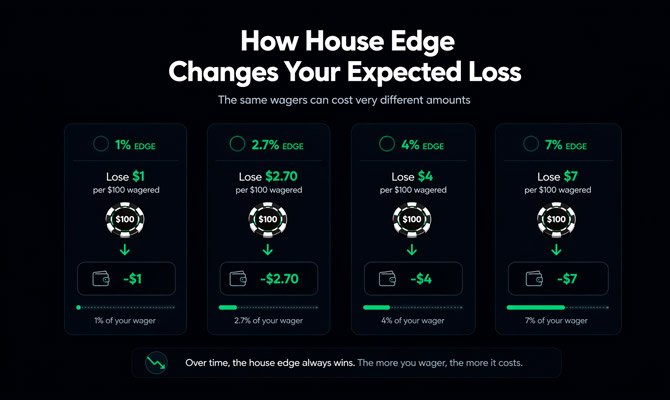
House edge is the percentage of every dollar you wager that the casino expects to keep over the long run. It’s built into the game’s rules and payout structure. For table games, the edge is determined by the ruleset — but operators can change your cost by choosing a different ruleset (6:5 vs 3:2 blackjack, American vs European roulette, different deck counts). For slots, operators can directly select from different RTP configurations for the same title, effectively setting the house edge.
The math is simple. European roulette has 37 pockets (1–36 plus a single zero). A straight-up bet pays 35-to-1, as if there were only 36 pockets. That one missing pocket — the zero — is the casino’s entire profit mechanism. The edge: 1/37 = 2.70%. American roulette adds a second zero (38 pockets, same 35-to-1 payout), pushing the edge to 5.26%. Same game, one extra pocket, nearly double the cost.
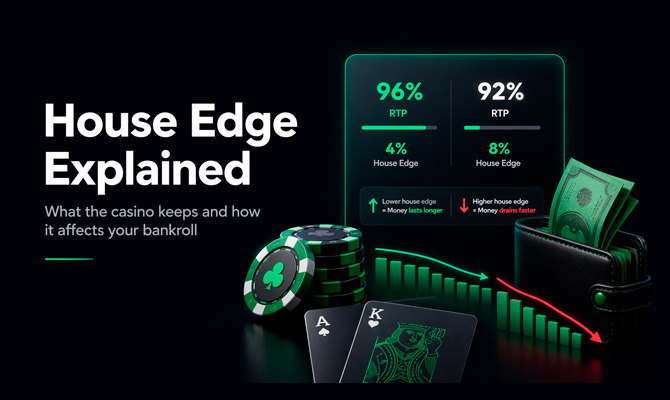
House edge and RTP (Return to Player) are two sides of the same number: House Edge + RTP = 100%. A 96% RTP slot has a 4% house edge. For a complete breakdown of RTP, see our RTP Explained guide.
Every Major Game Ranked by House Edge
This table ranks games by edge percentage — the cost per dollar wagered. The “skill required” column matters: some edges assume perfect strategy that most players don’t execute perfectly.
| Game / Bet | House Edge | Skill Required? | Edge Type |
|---|---|---|---|
| Craps — Odds bet | 0% | No (but requires Pass/Don’t Pass first) | Fixed |
| Video Poker (9/6 Jacks or Better) | 0.46% | Yes — optimal hold/draw strategy | Paytable-dependent |
| Blackjack (3:2, basic strategy) | 0.5% | Yes — memorized strategy chart | Rule-dependent |
| Baccarat — Banker (5% commission on wins) | 1.06% | No | Fixed |
| Baccarat — Player | 1.24% | No | Fixed |
| French Roulette (La Partage) | 1.35% | No | Fixed |
| Craps — Pass Line | 1.41% | No | Fixed |
| European Roulette | 2.70% | No | Fixed |
| Crash games (varies, typically 1–5%) | 1–5% | No (cashout timing is psychological, not mathematical) | Implementation-dependent |
| Online slots (default RTP ~96%) | 4.0% | No | Operator-configurable |
| American Roulette | 5.26% | No | Fixed |
| Online slots (reduced RTP ~93%) | 7.0% | No | Operator-configurable |
| Baccarat — Tie | 14.36% | No | Fixed |
| Keno | 20–40% | No | Varies |
The Number That Actually Matters: Cost Per Hour
House edge tells you the cost per dollar wagered. But your actual cost depends on how many dollars you wager per hour — and that’s driven by game speed. This is the insight most edge guides miss: a low-edge game played fast can cost more than a high-edge game played slow.
Expected cost/hour = Bet size × Rounds per hour × House edge
Here’s what that formula produces at typical play speeds. These are illustrative estimates — actual pace depends on the player, the platform, and the specific game variant. Use your total stake per round (not just the table minimum) — if you bet on multiple roulette numbers or multiple craps bets simultaneously, add them together.
| Game | Bet Size | Rounds/Hour (est.) | House Edge | Expected Cost/Hour |
|---|---|---|---|---|
| Blackjack (basic strategy)* | $10 | 60 | 0.5% | $3.45 |
| Baccarat (banker) | $10 | 70 | 1.06% | $7.42 |
| European Roulette | $5 | 30 | 2.70% | $4.05 |
| Crash game (3% edge example) | $2 | 120 | 3.0% | $7.20 |
| Online slot (96% RTP) | $1 | 500 | 4.0% | $20.00 |
| Online slot (93% RTP) | $1 | 500 | 7.0% | $35.00 |
| American Roulette | $5 | 30 | 5.26% | $7.89 |
*Blackjack note: optimal basic strategy requires doubling down and splitting, making your average wager per hand roughly 15% higher than your initial bet ($10 initial → ~$11.50 average action). The $3.45 figure reflects this. Players who don’t double/split lose the edge reduction that makes the 0.5% figure meaningful.
The table reveals the hidden cost of speed. Slots look cheap at $1 per spin, but 500 spins per hour means you’re wagering $500/hour. At 4% edge, that’s $20/hour in expected losses — roughly six times more than $10 blackjack. The game that feels cheapest per bet is often the most expensive per hour.
Three Bets That Look Reasonable But Aren’t
Baccarat Tie bet (14.36% edge)
First, a note on baccarat mechanics that the ranking table doesn’t fully explain: the banker bet’s 1.06% edge exists after the casino takes a 5% commission on every winning banker bet. You bet $10, the banker wins, you receive $9.50 (not $10). This commission is how the casino maintains its edge despite the banker hand winning slightly more often than the player hand. Many beginners don’t realize the payout isn’t 1:1 until they see the deduction.
Now the tie bet: the 8-to-1 payout looks attractive. But the true odds of a tie in standard 8-deck baccarat are roughly 9.5-to-1 — the casino pays 8-to-1 for an event that happens less often than the payout suggests. At 14.36%, the tie bet costs approximately 10× more per dollar wagered than the banker bet at the same table. There is no scenario in which this bet has positive expected value.
Blackjack insurance (7.69% edge)
When the dealer shows an ace, the casino offers “insurance” — a side bet that pays 2-to-1 if the dealer has blackjack. In a standard 6-deck shoe, the probability of a ten-value card underneath is roughly 30.8%, making the true odds worse than 2-to-1. Basic strategy says: never take insurance. It’s a separate bet with a high edge disguised as a safety mechanism.
Slot side features with separate RTP
Some modern slots include optional side bets, ante bets, or buy-in mechanics that run at a different house edge than the base game. An ante bet might increase the base bet by 25% in exchange for higher bonus frequency, but the overall RTP of the ante mode may be lower than the standard mode. Check the in-game help file — if the RTP changes when a feature is activated, the cost changes too.
What You Can Actually Control
You can’t change the house edge (it’s built into the game). But you can control three variables that determine how much it costs you:
1. Game selection. Choosing European roulette over American roulette cuts the edge nearly in half. Choosing a 96% RTP slot over a 93% RTP slot saves $30/hour at $1 bets. Game selection is the highest-leverage decision a player makes.
2. Bet size. Every variable in the hourly cost formula scales linearly with bet size. Halving your bet halves your expected cost. This is the simplest and most effective bankroll management tool.
3. Speed. Playing slower — whether by avoiding autoplay, taking breaks, or choosing games with inherently slower pace (roulette, baccarat) — reduces the number of rounds per hour and therefore the total amount wagered. Speed is the cost multiplier that most players ignore.
Want to run the numbers for your bet size and game? Our partner site has free calculators for house edge, expected value, and hourly cost.
Our quiz matches you with operators from our verified pool — factoring in game variety, bonus terms, and payment speed.
FAQ
What is house edge?
The percentage of each bet that the casino expects to keep over the long run. A 2% house edge means the casino keeps $2 for every $100 wagered, on average, across millions of bets. Your individual session can deviate widely from this average.
Which casino game has the lowest house edge?
Craps odds bet (0%), video poker with optimal strategy (0.46%), and blackjack with basic strategy (0.5%) have the lowest edges. For games requiring no skill, baccarat banker (1.06%) and European roulette (2.70%) are the best options.
Does house edge mean I’ll always lose?
Over a long enough period, yes — the math is designed to favour the casino over millions of bets. In any single session, however, outcomes are random. You can win in the short term, sometimes significantly. House edge describes the long-term trend, not any individual result.
Is the house edge the same at every casino?
For table games with fixed rules (roulette, baccarat, craps), yes — the edge is determined by the rules themselves. For slots, no — operators can select from different RTP configurations, effectively changing the house edge for the same game title. For blackjack, rule variations (6:5 vs 3:2 payout, dealer hits/stands on soft 17) change the edge. Always check the specific rules and RTP at your operator.
What’s the house edge on crash games?
Most crash games build their house edge through the probability of an instant bust — the game crashing at 1.00× before any player can cash out. For example, a crash game with a 3% edge is programmed so that approximately 3% of rounds end at the starting multiplier, and all bets are lost. The edge varies by implementation: casino originals (Stake, Gamdom) may run at 1–2%, while third-party crash games from providers like Spribe or SmartSoft typically run at 3–5%. Provably fair systems let you verify each round’s crash point but don’t change the edge itself.
How can I reduce my losses?
Three things you control: choose lower-edge games, bet smaller amounts, and play slower. Of these, game selection and bet sizing have the largest impact. Avoiding autoplay on slots and steering clear of high-edge bets (baccarat tie, American roulette, keno) are the simplest improvements.
Related
- What Is RTP and Why It Matters — the flip side of house edge, plus multi-RTP configs
- Casino Bonuses Explained — how house edge affects your wagering costs
- Free Spins: What 200 Free Spins Are Worth — EV calculations for bonus offers
- GamblingCalc — free house edge, EV, and hourly cost calculators