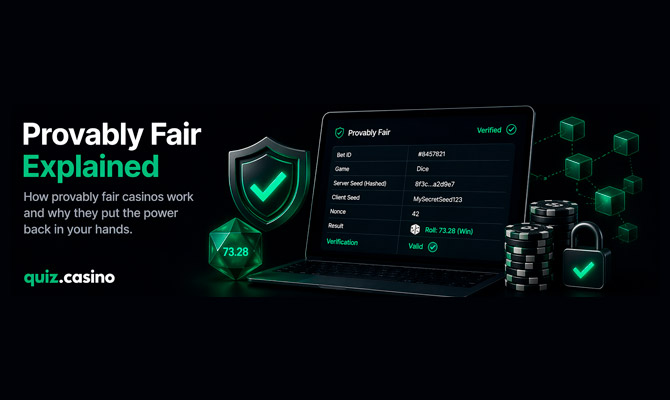

“Provably fair” is the most misunderstood term in crypto gambling. Some players think it means the casino can’t have an edge. Others think it guarantees they’ll be paid. Neither is true.
Provably fair is a specific cryptographic system that proves one thing: the casino did not change the outcome of a specific round after you placed your bet. That’s it. It’s a powerful guarantee — but it’s a narrow one, and understanding its boundaries is just as important as understanding how it works.
It proves: The casino committed to a cryptographic seed before you bet. That seed, combined with your input, determined the result — and the casino could not swap the seed after seeing your wager.
It does NOT prove: That the RTP is accurate. That the house edge matches what’s advertised. That your funds are safe. That the platform is licensed or trustworthy. That you’ll be paid when you win. Provably fair verifies round integrity, not platform integrity.
How Provably Fair Works (The Simple Version)
Every provably fair system follows a three-step pattern: commit, play, reveal. Here’s how it works without the jargon:
Step 1: The casino commits to a seed before you bet
The casino generates a secret value called a server seed and shows you its hash — a cryptographic fingerprint that uniquely identifies the seed without revealing it. In simple implementations, the casino generates a new seed periodically. In more advanced systems (used by platforms like Stake and Bustabit), the casino generates a hash chain: one seed for millions of future rounds, where each round’s seed is derived by hashing the next. This chain is committed in advance, making it mathematically impossible for the casino to swap any seed without breaking the entire chain.
Think of it like a sealed envelope. The casino writes the answer inside, seals it, and shows you the sealed envelope before you bet. You can see the envelope exists, but you can’t read what’s inside.
Step 2: Player input is added
In single-player games (dice, mines, Plinko), you contribute a client seed — a value generated by your browser or one you set manually. A nonce (a counter that increases by 1 with every bet) is also included. These three inputs — server seed, client seed, and nonce — are combined through a public algorithm to generate the game result.
In multiplayer games (crash, Aviator), the model is different. The round result is typically generated from the server seed combined with seeds from the first players to bet in that round — not from your personal client seed. If you bet later in the round, your individual seed may not participate in the result calculation. The key guarantee remains the same: the server seed was committed via hash before the round started.
Because the casino committed to its seed before seeing any bets, it cannot retroactively manipulate the outcome.
Step 3: The casino reveals the seed after the round
After the game (or when you rotate seeds), the casino reveals the original server seed. You can now hash it yourself and verify that it matches the hash you were shown before the bet. If it matches, the casino used the seed it committed to — it didn’t switch the answer after seeing your bet.
Server seed — the casino’s secret input, committed via hash before play.
Client seed — the player’s input (single-player games) or public player data (multiplayer).
Nonce — a counter that ensures unique results even with the same seeds.
Many implementations use HMAC-SHA256 to combine these inputs, but the exact algorithm varies by platform and game type. The principle is the same: deterministic, verifiable, committed in advance.
How to Verify a Round
Verification is the whole point — if you never check, provably fair is just marketing. Here’s the process:
- Find the round data. Open the game’s fairness panel or bet history. You need: the hashed server seed (shown before the bet), your client seed, and the nonce for that round.
- Reveal the server seed. Some games reveal it automatically after each round; others require you to rotate seeds (which ends the current seed pair and reveals the old server seed).
- Check the hash. Hash the revealed server seed using SHA-256. The result must exactly match the hash you were shown before the bet. If it doesn’t match, the casino changed the seed — this is evidence of manipulation.
- Recompute the result. Enter the server seed, client seed, and nonce into a verification tool (the casino’s built-in verifier or an independent third-party tool). The computed result should match what you saw in the game.
What Provably Fair Does NOT Guarantee
This is the section that matters most. Provably fair is a narrow cryptographic proof, not a comprehensive safety certificate. Here’s what it explicitly does not cover:
1. Single-round verification doesn’t validate RTP
Provably fair proves each individual round was generated from the committed seed. On its own, single-round verification does not prove that the aggregate return-to-player percentage matches what’s advertised. However — and this is an advantage over closed RNG systems — when the algorithm mapping seeds to outcomes is public (as it is at many crypto platforms), anyone can generate millions of simulated results from the published hash chain and mathematically calculate the theoretical house edge built into the code. This is technically demanding but entirely possible, and it’s something that’s impossible with traditional proprietary slot algorithms. The distinction: provably fair lets you verify individual round integrity easily and aggregate RTP with effort — traditional RNG lets you verify neither without relying on an auditor.
2. It doesn’t protect your funds
Provably fair is a game-level feature. It says nothing about whether the casino will let you withdraw your winnings, whether your account will be arbitrarily closed, or whether the operator will disappear with your balance. A platform can run perfectly provably fair games while being financially insolvent, unlicensed, or actively scamming users on the payment side.
3. It doesn’t replace licensing
“We’re provably fair” is not a substitute for regulatory oversight. Licensing covers fund segregation, dispute resolution, responsible gambling tools, AML compliance, and operational standards that provably fair technology doesn’t address. A licensed casino without provably fair may be safer than an unlicensed casino with it. For more on how licensing protects players, see our Licences Explained guide.
4. It doesn’t mean you can’t lose
The house edge exists inside provably fair games just as it does in traditional casino games. The edge is baked into the algorithm — it’s transparent and verifiable, but it’s still there. Provably fair means the casino can’t cheat beyond its stated edge. It doesn’t mean you’ll win.
Which Games Are Provably Fair?
Provably fair is most common in casino-original games — titles built by the operator itself, not by third-party providers. These are the game types where you’ll find it:
| Game Type | Provably Fair? | Examples |
|---|---|---|
| Crash games | Almost always | Stake Crash, BC.Game Crash, Bustabit |
| Dice | Almost always | Stake Dice, Primedice |
| Plinko | Usually | Stake Plinko, BC.Game Plinko |
| Mines / Keno / Limbo | Usually | Casino originals at major platforms |
| Third-party slots | Rarely | BGaming offers PF on some titles; most providers don’t |
| Live dealer games | No | Physical cards/wheels — different fairness model |
| Third-party table games | Rarely | Most use certified RNG instead |
Provably Fair vs Certified RNG: Which Is Better?
| Feature | Provably Fair | Certified RNG |
|---|---|---|
| Who verifies? | The player (individually) | Independent testing lab (periodically) |
| What’s verified? | Each individual round’s integrity | Statistical distribution over millions of rounds |
| Transparency | Algorithm is public; seeds are available | Algorithm is proprietary; audit reports may be public |
| RTP verification | Not directly (requires separate statistical analysis) | Yes — auditors test aggregate RTP compliance |
| Common in | Crypto casino originals | Third-party provider slots and table games |
| Requires trust in | The algorithm’s implementation | The auditor and the casino’s compliance |
Neither system is strictly superior. Provably fair gives individual players more direct verification power. Certified RNG provides aggregate statistical assurance that provably fair doesn’t. The ideal is both: a platform where casino originals are provably fair and third-party games are from certified providers. Many major crypto casinos (Stake, BC.Game, Gamdom) operate exactly this hybrid model.
Red Flags: When “Provably Fair” Is Just Marketing
Some platforms use the term without fully implementing the system. Check for these signs:
No server seed hash shown before the bet. If you can’t see the hashed server seed before placing your wager, there’s no cryptographic commitment — the casino could generate the result after seeing your bet.
No way to change the client seed. If the client seed is locked or hidden, you have no input into the result generation. The casino controls both variables.
No verification tool — or only the casino’s own tool. If the only way to verify is through the casino’s interface with no access to raw seeds/hashes, verification is performative. You need the raw data to check independently.
The algorithm isn’t documented. If the casino doesn’t publish how server seed + client seed + nonce are combined to produce the result, you can’t reproduce the calculation even with all the inputs.
Seeds are never revealed. If the casino doesn’t reveal the server seed (ever), the hash commitment is meaningless — you can never verify whether the hash matched the actual seed used.
Our quiz matches you with operators from our verified pool — including which platforms offer provably fair originals alongside licensed third-party games.
FAQ
Does provably fair mean the casino has no house edge?
No. The house edge is built into the game’s algorithm — it’s transparent and verifiable, but it’s still there. Provably fair means the casino can’t cheat beyond its stated edge. It doesn’t change the edge itself.
Can I hack or predict provably fair games?
No. In a correctly implemented provably fair system, predictor apps cannot know the next result before the server seed is revealed. The commitment is based on one-way hash logic — the server seed cannot be reverse-engineered from its hash. “Crash predictor” apps are scams: they can’t access the server seed and don’t break any cryptography. For more on why prediction is impossible, see our crash games coverage at CrashGamesPlay.
Are provably fair casinos safer than regular casinos?
Not necessarily. Provably fair verifies game outcomes. Platform safety depends on licensing, fund protection, payment reliability, and operator reputation — none of which provably fair addresses. A licensed casino without provably fair can be safer than an unlicensed casino with it.
Does changing my client seed improve my odds?
No. Changing the client seed changes the sequence of results but not the mathematical odds. The house edge remains the same regardless of which seed you use. Seed changes give psychological control, not mathematical advantage.
Are slots provably fair?
Most third-party slots (Pragmatic Play, Hacksaw, Nolimit City) are not provably fair — they use certified RNG tested by independent labs. A few providers, notably BGaming, offer provably fair verification on some slot titles. Casino-original games (crash, dice, Plinko) are almost always provably fair at crypto platforms.
What is SHA-256?
SHA-256 (Secure Hash Algorithm 256-bit) is a cryptographic hash function — not encryption. It takes any input and produces a fixed 64-character output. Key properties: it’s one-way (you can’t reverse-engineer the input from the output), deterministic (same input always produces the same output), and collision-resistant (effectively impossible to find two different inputs that produce the same output). It’s the same algorithm that underpins Bitcoin’s blockchain. These properties are what make provably fair commitments tamper-proof.
Related
- Best Casinos for Crash Games — platforms with provably fair originals
- Curaçao vs MGA Licence — why licensing matters alongside provably fair
- How to Check If a Casino Is Legit — the full 7-point checklist
- CrashGamesPlay — crash game mechanics, strategies, and provably fair verification