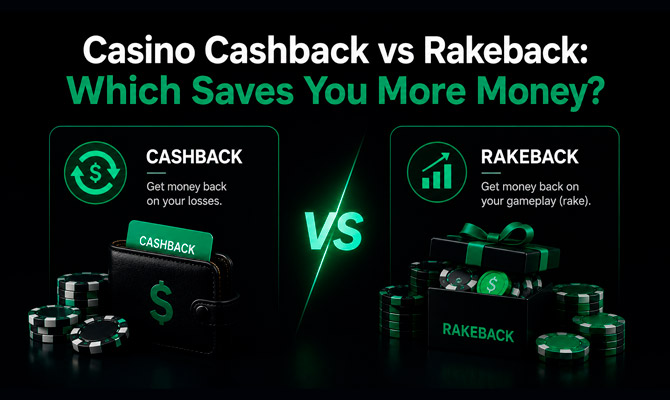

Both cashback and rakeback put money back in your pocket. But they work on completely different triggers, and depending on how you play, one can be worth significantly more than the other.
Most casino players treat these terms as interchangeable. They’re not. Cashback is insurance against bad sessions. Rakeback is a rebate on every bet you place, win or lose. The difference matters — especially if you play at volume.
- Cashback = % of your net losses returned. You only receive it when you lose.
- Rakeback = % of the house edge returned on every bet. You receive it whether you win or lose. (Some platforms calculate it as a % of total wager instead — very different in dollar terms.)
- For losing sessions, loss-based rewards return more per dollar lost
- For consistent volume, per-bet rebates return more over time
- Many platforms emphasise one model, but some combine both across different layers of their loyalty program
- The most important rule: the percentage and calculation basis matter more than the label. Always translate into expected dollar returns at your play volume.
How Cashback Works
Cashback returns a percentage of your net losses over a defined period — usually a day, a week, or a month. The keyword is “net”: if you deposit $500, win $200, lose $700, your net loss is $500. A 10% cashback gives you $50 back.
The critical detail: this reward only activates when you’re down. If you finish a session in profit — even by $1 — you receive nothing. It’s a safety net for losing streaks, not a reward for playing.
This type of reward is typically calculated on one of two bases: net losses on deposits made during the promotional period, or net losses across all gameplay in a given timeframe. The difference matters: the first penalises you if you deposit and withdraw multiple times in a week; the second tracks your actual play regardless of deposit/withdrawal activity.
Typical cashback terms
| Parameter | Common range |
|---|---|
| Percentage | 5–20% (up to 35% for VIP tiers) |
| Frequency | Daily, weekly, or monthly |
| Wagering on cashback | Often 0× (real money) — but check terms |
| Cap | Varies — some uncapped, others limit to $500–$5,000 |
How Rakeback Works
Rakeback returns a percentage of every bet you place, regardless of whether you win or lose that bet. The name comes from poker, where the “rake” is the house’s commission on each pot. In the casino context, there are two main calculation models — and the difference between them is significant:
Edge-based rakeback (most common at crypto casinos)
Formula: Total Wagered × House Edge × Rebate %
This is what platforms like Stake and BC.Game use. Your return is a percentage of what the house expects to keep from your play. Example: you wager $10,000 on slots with a 3% house edge. The house expects to keep $300. If your rebate rate is 10%, you get $30 back — regardless of your actual outcome.
Wager-based rakeback (less common, much more generous)
Formula: Total Wagered × Rebate %
Here the return is a flat percentage of your total wagers, ignoring the house edge. A 1% wager-based return on $10,000 wagered = $100 back. This is far more valuable than 10% edge-based return on the same amount ($30). When you see rakeback numbers, always check which base they apply to.
The critical detail: the per-bet return never stops. Win $5,000 on a hot streak? You still earn on every spin. This makes it fundamentally different from cashback, which goes silent the moment you’re in profit.
Typical rakeback terms
| Parameter | Common range |
|---|---|
| Percentage | 5–25% of house edge (up to 40% at top VIP tiers) |
| Frequency | Instant, daily, or weekly |
| Wagering on rakeback | Usually 0× (credited as real money) |
| Scales with VIP | Yes — almost always tied to loyalty tier |
The Math: Same Player, Two Systems
Let’s run a concrete scenario. Same player, same games, same volume — but one platform offers 10% cashback and the other offers 10% rakeback.
Player profile
Deposits $1,000. Plays slots with 3% house edge. Total wagers: $20,000 over one week. Expected loss at 3% edge: $600. Actual result: lost $600 (exactly at expectation).
Loss-rebate result
Net loss = $600. 10% of $600 = $60 returned. Effective loss = $540.
Per-bet rebate result
Total wagered = $20,000. House edge = 3%. House’s expected take = $600. 10% of $600 = $60 returned. Effective loss = $540.
In this scenario, the numbers are identical. But watch what happens when the outcomes change:
Scenario B: Player wins
Same $20,000 wagered, but the player runs hot and finishes the week up $400 (net profit).
Cashback: $0 returned. No loss = no cashback. Total: +$400.
Rakeback: Still $60 returned (10% of $600 expected house take). Total: +$460.
Scenario C: Player loses heavily
Same $20,000 wagered, but the player runs cold and finishes down $1,200 (double the expected loss).
Cashback: 10% of $1,200 = $120 returned. Effective loss = $1,080.
Rakeback: Still $60 returned (based on wager × edge, not actual loss). Effective loss = $1,140.
Which Is Better for You
There’s no universal answer — it depends on how you play:
| Player type | Better model | Why |
|---|---|---|
| High-volume grinder | Rakeback | Compounds on every bet. Never stops. Scales linearly with play volume. |
| Casual weekend player | Cashback | Provides a safety net on losing sessions without requiring consistent volume. |
| Winning player (short-term) | Rakeback | Cashback returns $0 during winning sessions. Rakeback keeps paying. |
| Loss-averse player | Cashback | Directly reduces the sting of bad sessions. Psychologically easier to value. |
| VIP / high-roller | Rakeback (usually) | VIP rakeback tiers at most crypto platforms are more generous than VIP cashback tiers. |
One important caveat: the percentage matters more than the model. A 20% cashback on losses is almost certainly worth more than a 5% rakeback on house edge — the model is secondary to the actual number. Always compare the expected dollar return at your typical play volume, not just the label.
How Crypto Casinos Implement These
In practice, most crypto casinos blend both models into their loyalty programs. Here’s how the approach varies across different platform types:
Rakeback-first platforms
Platforms like BC.Game and Stake build their VIP ecosystem around edge-based rakeback. The rebate percentage scales with your loyalty tier — starting low and increasing as you accumulate wagering volume. Both platforms supplement per-bet rebates with periodic cashback at higher tiers, but the continuous edge-based return is the core mechanic.
Cashback-first platforms
Platforms like Winz and Roobet currently emphasise loss-based rewards. Winz offers 20% daily cashback on net crypto losses during the welcome period, with zero wagering requirements. Roobet’s onboarding promotes a 7-day cashback window. Both may also include per-bet rebates through loyalty tiers, but the flagship promotion is loss-based.
Hybrid and alternative approaches
Gamdom publicly markets both rakeback-style rewards and enhanced RTP on selected slots — artificially raising payout rates, which functionally reduces the operator’s margin on every spin. This is an indirect form of per-bet return baked into the game rather than paid separately. Shuffle combines instant per-bet rebates with tournament prize pools. These blended models are becoming more common as platforms compete for players who value both session-level protection and volume-based rewards.
Common Traps to Watch
1. “Cashback” with wagering requirements
Some operators call their promotion “cashback” but attach 1×–5× wagering before you can withdraw the returned funds. This transforms cashback into a standard bonus with extra steps. Genuine cashback is credited as real, withdrawable money with zero rollover.
2. Per-bet rewards that don’t unlock until high VIP tiers
Several platforms advertise rakeback as a feature but don’t activate it until you reach a specific loyalty level — which can require tens of thousands of dollars in lifetime wagers. If per-bet rebates are a deciding factor for you, verify at what tier it actually begins.
3. Cashback calculated on deposits, not losses
A subtle but important distinction. If cashback is calculated on “deposits made during the period” rather than “net losses during the period,” withdrawing and re-depositing within the same week can reset your loss calculation. Read the terms to understand the exact calculation basis.
4. Conflating rakeback percentage with cashback percentage
A 10% edge-based rebate and a 10% loss-based rebate are not the same number in dollars. On $10,000 wagered at 3% house edge: the per-bet return is $30; the loss-based return is $30 only if you lost exactly $300. If you lost more, the loss-based reward pays more; if you lost less or won, the per-bet reward pays more. Always translate percentages into expected dollar returns at your play level.
5. Bonuses that cannibalise your cashback base
At most platforms, the net loss formula for cashback is: (total deposits) − (total withdrawals) − (bonuses received) − (current balance). This means any other bonuses you’ve claimed — reload offers, free spin winnings, VIP roulette prizes — are subtracted from your loss base before cashback is calculated. If you lost $1,000 but received $300 in other promotions during the same period, your cashback base is $700, not $1,000. You’re effectively paying for those other bonuses with reduced cashback.
6. The timeframe trap (daily vs weekly cashback)
The calculation window changes the math dramatically. Example: Monday you lose $1,000 (daily cashback at 10% = $100 returned). Tuesday you win $1,000. With daily cashback, you keep the $100 from Monday — your week ends at +$100. With weekly cashback calculated on Sunday, your net loss for the week is $0, so you receive nothing. Same play, same outcomes, but the daily window returned $100 more. When comparing platforms, check the settlement frequency — daily cashback is mathematically better for the player than weekly or monthly, because winning days can’t cancel out losing days retroactively.
Want to find platforms that match your reward preference?
FAQ
What’s the difference between cashback and rakeback?
Cashback returns a percentage of your net losses — you only get it when you lose. Rakeback returns a percentage of the house edge or total wager on every bet — you get it whether you win or lose. They use the same percentage label but measure different things.
Can I get both cashback and rakeback at the same casino?
At some platforms, yes. Several crypto casinos offer edge-based rebates as a continuous VIP mechanic and loss-based rewards as a periodic promotion. However, since both are typically funded from the same revenue pool, they don’t always stack at full value simultaneously. Some platforms — like Gamdom — publicly advertise both. Check the specific terms to understand which rewards are active at your tier and whether they compound or replace each other.
Which is better for slot players?
For high-volume slot players, per-bet rewards tend to return more over time because it compounds on every spin regardless of session outcome. For casual players who play infrequently, loss-based rewards provide better protection on individual losing sessions. The percentage and terms matter more than the model itself — always calculate expected dollar returns at your typical volume.
Is rakeback the same as reduced house edge?
Effectively, yes. If a slot has a 3% house edge and you receive 10% rakeback on that edge, your effective house edge drops to 2.7%. Some platforms achieve this directly by offering “Boosted RTP” slots that run at higher return rates, rather than paying rakeback separately. The mathematical result is similar — you retain more per dollar wagered.
Do cashback and rakeback have wagering requirements?
At most reputable crypto platforms, both cashback and rakeback are credited as real money with zero wagering. But this isn’t universal — some operators attach rollover conditions (1×–5×) to cashback returns or credit rakeback as bonus funds. Always verify the specific terms before relying on these rewards as part of your strategy.
Further Reading
- Bonus wagering math — understand rollover before accepting any promotion
- Casinos like Stake — comparison of VIP and reward models across platforms
- House edge explained — what the casino keeps and how it affects your returns
- No deposit bonuses — are they actually worth claiming?